
Books Every Woman Healing Her Relationship Patterns Should Read — Therapist Picks
This post contains affiliate links. I may earn a small commission at no cost to you. I only recommend products I'd genuinely suggest to a client.

There's a specific moment I see in therapy, usually a few sessions in, where a client says something like "I just wish someone had given me a manual for this."
She means for love. For why she keeps ending up in the same dynamic with different people. For why leaving is so hard even when staying hurts. For why she can have every other area of her life together and still fall completely apart in a relationship.
The books on this list are as close to that manual as I've found.
I've been recommending these titles to clients for years. Some of them I read before I became a therapist and they changed the way I understood myself. Others I discovered in my clinical training and immediately started pressing into the hands of every woman I worked with.
None of them are quick fixes. But all of them have the capacity to fundamentally shift the way you understand your patterns, and that shift is where healing begins.
Before You Start Reading, A Note on How to Use These Books
I want to offer a gentle clinical caution before we get into the list.
Reading about your patterns can be deeply illuminating. It can also, for some women, become another form of the same hypervigilance that anxious attachment already produces, analyzing, categorizing, trying to think your way to healing.
These books are tools, not destinations. Read them with curiosity rather than urgency. Underline what resonates. Put them down when you need to. And remember that insight alone doesn't change patterns, embodied experience does. These books are most powerful when they're paired with actual practice, whether that's journaling, therapy, or simply making different choices in your relationships one small moment at a time.
With that said, here are the ones worth your time.
The Books
For understanding your attachment style:
Attached: The New Science of Adult Attachment and How It Can Help You Find — and Keep — Love by Amir Levine and Rachel Heller Get it here
This is always the first book I recommend. Always.
Attached breaks down adult attachment theory, the science of how we bond, why we bond the way we do, and what happens when two different attachment styles try to build a relationship together, in language that is accessible without being dumbed down.
What makes this book so transformative for most women is the reframe it offers. You stop reading your relationship history as a series of personal failures and start seeing it as two attachment systems doing exactly what they were wired to do.
The anxious-avoidant trap, where the anxious partner pursues and the avoidant partner withdraws, each one triggering the other's deepest fears, is explained with a clarity that makes you want to text your ex and say "so THAT'S what was happening."
More importantly, it gives you a map forward. Understanding your attachment style is the foundation everything else on this list is built on. Start here.
Why Does He Do That? Inside the Minds of Angry and Controlling Men by Lundy Bancroft Get it here
I include this one carefully and intentionally.
Not every woman healing her relationship patterns has been in an abusive relationship. But a significant number of the women I work with have been in relationships with controlling, manipulative, or emotionally abusive partners, and didn't have language for it until long after they left.
Lundy Bancroft spent decades working with abusive men in court-ordered programs. This book is written from the inside out, it explains the thinking patterns, justifications, and tactics of controlling partners with a specificity that is both clarifying and, for many women, deeply validating.
If you've ever left a relationship feeling like you lost your mind, like you couldn't trust your own perceptions anymore, this book may give you some of it back. It is not a light read. But for the women who need it, it is one of the most important books on this list.
For understanding where the patterns came from:
Adult Children of Emotionally Immature Parents: How to Heal from Distant, Rejecting, or Self-Involved Parents byLindsay Gibson Get it here
I have recommended this book more times than I can count. I have had clients finish it and come to the next session looking genuinely lighter, like something they'd been carrying for years finally had a name.
Emotionally immature parenting doesn't always look dramatic. It doesn't require abuse or neglect in the traditional sense. It can look like a parent who was physically present but emotionally unavailable. A parent whose moods were unpredictable and whose children learned to manage those moods to keep the peace. A parent who needed their child to be okay so that they could be okay.
Sound familiar?
Gibson explains how growing up with an emotionally immature parent shapes your nervous system, your self-concept, and your relationship patterns as an adult, and what healing from that specific wound looks like.
If you've ever wondered why you're so attuned to other people's emotional states, why you find it hard to identify your own needs, or why you feel responsible for the emotional wellbeing of everyone around you, this book is for you.
Women Who Love Too Much: When You Keep Wishing and Hoping He'll Change Get it here
This is the classic. First published in 1985 and still one of the most relevant books on this list because the pattern it describes hasn't changed, only the platforms we perform it on have.
Norwood writes specifically about women who become so focused on a partner's problems, potential, and pain that they lose themselves entirely in the process. The woman who mistakes caretaking for love. The woman who is more comfortable with a man's struggle than with a man's stability. The woman who keeps choosing partners who need fixing because that's the only version of love that feels familiar.
If you've ever found yourself more attracted to someone's potential than their reality, this book will name something you've probably never been able to name before.
It reads quickly, it's deeply honest, and it has held up remarkably well for a book written four decades ago. A timeless read for a timeless pattern.
For understanding your body's role in all of this:
The Body Keeps the Score: Brain, Mind, and Body in the Healing of Trauma by Bessel van der Kolk Get it here
This book changed how I practice therapy and how I understand my own history. I don't say that lightly.
Van der Kolk spent decades studying trauma and its effects on the brain and body, and what he found is that trauma isn't primarily a story we tell about the past. It's a physiological state that lives in the body, shaping our nervous system responses, our relationships, and our sense of safety in the world long after the original experience is over.
For women healing relationship patterns, this book is essential because it explains why cognitive understanding alone isn't enough. You can read every book on this list, understand your attachment style intellectually, know exactly what your patterns are, and still find yourself repeating them in your next relationship. That's not a failure of willpower or insight. That's a nervous system that hasn't yet had the corrective experiences it needs to feel safe.
This book validates that experience and points toward what actually helps. It's a denser read than the others on this list but it is worth every page.
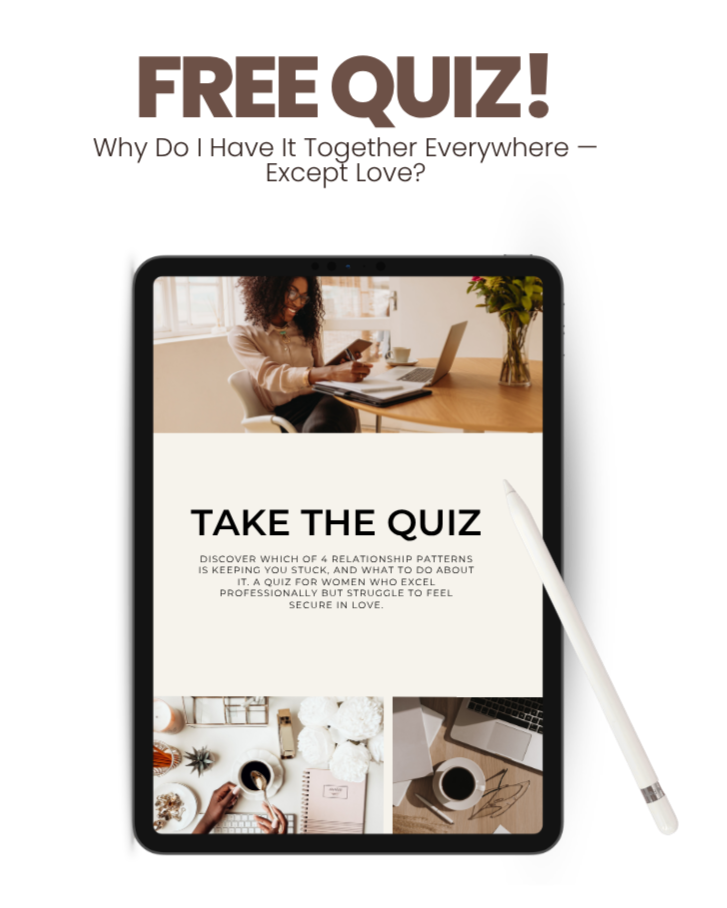
Why Do You Have It Together Everywhere — Except Love?
Take this free quiz to name the exact pattern showing up in your relationships, so you finally understand why it keeps happening.
For rebuilding after you understand the pattern:
Codependent No More: How to Stop Controlling Others and Start Caring for Yourself by Melody Beattie Get it here
Another classic that belongs on every healing reading list.
Codependency gets misused as a buzzword but Beattie's original framework is genuinely useful, particularly for high-achieving women who have organized significant parts of their identity around being needed, being helpful, or being the one who holds everything together.
This book is less about the relationship you were in and more about the relationship you have with yourself. It asks hard questions about where your sense of worth comes from, what you've been trying to control and why, and what it actually looks like to take care of yourself without making that care contingent on other people's behavior or approval.
It's the book I recommend when a client has done the work of understanding her patterns and is ready to ask: so who am I when I'm not orbiting someone else's needs?
Set Boundaries, Find Peace: A Guide to Reclaiming Yourself by Nedra Tawwab Get it here
Nedra Tawwab is a therapist and one of the clearest voices on boundaries I've come across. This book is practical in the best sense, it doesn't just explain why boundaries matter, it walks you through what they look like in specific relationships, how to communicate them, and how to hold them when the people in your life push back.
For women with anxious attachment, boundaries are often the hardest piece of the healing work. The fear of abandonment makes limit-setting feel catastrophically risky, like being honest about your needs will cause the very loss you're most afraid of. Tawwab addresses that fear directly and with compassion.
If you've ever said yes when you meant no, stayed quiet when you needed to speak, or found yourself resentful and exhausted from overextending, this book gives you the language and the framework to start changing that.
When Women Stop Hating Their Bodies by Jane Hirschmann and Carol Munter Get it now
I include this one because body image and relationship patterns are more connected than most healing resources acknowledge.
For many high-achieving women the way they relate to their body mirrors the way they relate to love, with criticism, conditions, and a persistent sense that they are not yet enough. Healing one without addressing the other often leaves a gap.
This book isn't about dieting or fitness. It's about the psychological relationship between women and their bodies, how it forms, how it distorts self-worth, and how to build a relationship with your physical self that is rooted in care rather than control. For some women this will feel peripheral to relationship healing. For others it will feel like the missing piece.
Want to Know Your Specific Pattern Before You Start?
These books will give you the framework. My free quiz gives you the specifics.
"Why Do I Have It Together Everywhere — Except Love?" takes three minutes and tells you exactly which of four attachment profiles has been running your relationships — The Overfunctioning Achiever, The Anxious Analyzer, The Guarded Romantic, or The Armored Achiever — along with what healing looks like for your specific pattern.
Most women find it clarifying in a way that makes everything on this reading list land even harder. The patterns we carry in love don't always have obvious names, but they do have names.
The quiz is a good place to start finding yours. It takes about two minutes, it's free, and it might give language to something you've been feeling for a while but couldn't quite articulate.
And if you're in Texas or Florida and you're ready to do this work with support — Grace & Growth Center has virtual therapy openings for high-achieving women ready to heal their relationship patterns for good.
→ Book a free consultation: 15 minutes to see if we’re a good fit
KEEP READING
More for the high-achieving woman.


Ready to stop reading about it and actually change it?
Book a free 15-minute consultation — no pressure, no commitment.

You know he's not good for you. Your friends see it. Your body feels it. So why can't you walk away? This post gets honest about the real reasons letting go feels impossible, even when you know better.