

How to Set Boundaries Without Guilt
This post contains affiliate links. I may earn a small commission at no cost to you. I only recommend products I'd genuinely suggest to a client.

Most people who struggle with boundaries aren't struggling because they don't know what they need.
They know. They can feel it. The tightening in the chest when they're about to say yes to something they don't have the capacity for, the quiet resentment that builds when they do it anyway, the exhaustion of constantly arranging themselves around other people's comfort.
The knowing isn't the problem. The problem is that somewhere along the way, having needs felt dangerous. And that lesson, absorbed early, reinforced often, doesn't just disappear because you've read enough about boundaries to know you should have them.
Why your body reacts the way it does
When you try to set a boundary and immediately feel the guilt flood in, the chest tighten, the urge to explain yourself, to soften it, to make sure no one is upset, that's not weakness. That's a nervous system doing exactly what it learned to do.
For a lot of women, the early message about love was that it required a particular kind of flexibility. Being agreeable. Being easy. Not taking up too much space or making things complicated. Love, in that model, looked like accommodation, and need looked like burden.
So your nervous system drew a conclusion that made sense at the time: if I push back, I risk the connection. If I say no, something important might break.
That conclusion kept you safe once. It helped you navigate relationships and environments where your needs genuinely weren't welcome. The problem is that your nervous system is still running that same calculus in situations where it no longer applies, where the people around you are actually capable of handling your limits, where saying no wouldn't end anything, where there is no real threat. The alarm goes off anyway, because the body doesn't automatically update its threat assessments just because the circumstances have changed.
The guilt you feel when you set a boundary isn't a sign that you've done something wrong. It's a sign that you're doing something unfamiliar.
Over-explaining is protection, not clarity
Notice what happens when you try to decline something or hold a limit. For most people who struggle with boundaries, the no doesn't come out clean. It comes wrapped in context.
I'm so sorry, I just have a lot going on right now, and I really wish I could, and I don't want you to think I don't care, but...
This isn't rudeness or poor communication. It's a very old survival strategy. At some point, a simple no wasn't enough. You learned that you had to make your limits make sense to someone else before they'd be accepted. That other people's comfort with your boundary mattered as much as the boundary itself. That you were responsible for managing how your limits landed.
Over-explaining is the body trying to prevent a rupture. It's saying: please don't be hurt by this, please still love me, please let me keep the connection.
Understanding where it comes from doesn't mean you have to keep doing it. But it does mean you can stop being frustrated at yourself for it. You were protecting something that mattered. Now you're learning that the protection isn't always necessary.
A boundary doesn't need to be convincing
Here's something that sounds simple and lands very differently in the body: a boundary only needs to be clear. Not comfortable, not perfectly understood, not received without friction. Just clear.
You do not owe the person on the other end of your boundary a backstory. You don't owe them reassurance that you still care about them, or emotional labor to manage their disappointment, or an explanation detailed enough that they'd have to agree it's reasonable. Their agreement is not required.
I won't be able to do that. Full sentence. Complete thought.
The first several times you try this, without the apologies, without the paragraphs of context, it will feel wrong. Your nervous system will interpret the brevity as cruelty, the absence of over-explanation as abandonment. That feeling is real and it's old and it is not accurate information about what's actually happening.
Short and clear is not cold. It's just honest.
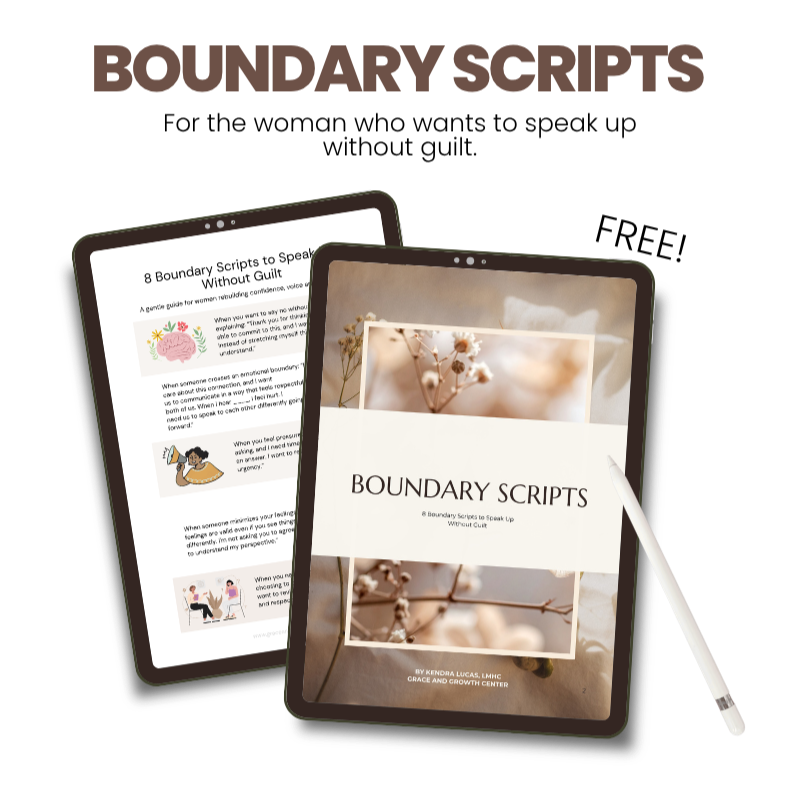
Know What You Need to Say — Just Not How to Say It?
This free guide gives you the exact words for the boundary conversations you keep avoiding, so you can protect your peace without over-explaining yourself.
Guilt doesn't mean you've sone something wrong
This is probably the most important thing to understand about the guilt that comes with boundaries, especially early on: guilt is not a reliable moral compass. It's a pattern detector.
When you've spent years, or a lifetime, organizing yourself around other people's needs, your baseline is self-abandonment. That's what feels normal. That's what feels like love and responsibility and being a good person. So when you do something that breaks that pattern, when you actually honor your own limit, it registers as a violation. The guilt shows up not because you've done something harmful, but because you've done something different.
The guilt is your nervous system saying: this isn't how we usually do things. It's not your nervous system saying: this was wrong.
You can let guilt show up without negotiating with it. You can feel it and not act on it. You can notice it, recognize it for what it is, and let it pass without dismantling the boundary it arrived to challenge. This takes practice. But guilt that you don't capitulate to eventually loses some of its authority.
What you're actually building
Every time you hold a limit, even imperfectly, even with shaking hands and a voice that's slightly too apologetic, something shifts.
Your body gets a small piece of evidence: I said what I needed, and I survived it. The relationship didn't end. I didn't become a bad person. I'm still here.
Over time, those small pieces accumulate into something that looks like self-trust. Not the kind you can think your way into, but the kind that lives in the body. The quiet, cellular knowledge that you are safe with yourself. That your needs won't be abandoned by the one person who is always there: you.
This is how anxiety softens around relationships. Not by eliminating the discomfort of boundaries, but by building enough internal safety that the discomfort stops feeling like catastrophe.
If you're in the thick of this right now, I put together a resource list of journals I recommend to clients working through similar phases in their lives.
You were trained to survive without them
I want to offer this reframe, because I think it matters more than any tactical advice about how to word a boundary.
You are not bad at this. You are not a people-pleaser because you're weak or because you lack self-respect. You are someone whose nervous system found a way to stay connected in environments where your needs weren't fully welcome, and it worked. You stayed loved, or safe, or both.
Now you're in a different chapter. And you're learning something new, with a nervous system that's still running the old software. That takes time. It takes repetition. It takes a lot of self-compassion for the moments when the guilt wins and you over-explain anyway and then feel the familiar frustration.
Those moments matter even more when your environment supports them. Here are some of the tools I recommend for creating that kind of space.
A note on support
If boundary-setting consistently triggers intense guilt, anxiety, or fear of abandonment, if holding your limits feels less like occasional discomfort and more like a full-body emergency, that's worth exploring with support.
Those reactions usually have roots. And understanding where they come from, in a space where you can actually slow down and look at them, tends to make them a lot less powerful.
If you're in this season, this list of books every woman should read has everything I'd put in your hands right now.
Journal Prompts for Women Learning to Set Boundaries
What drains me emotionally right now?
Where am I overextending myself?
What am I afraid will happen if I set a boundary?
What relationships feel one-sided?
What am I tolerating that I shouldn’t be?
What does a healthy boundary look like for me?
What do I need more of in my life?
What do I need less of?
What have I been ignoring about my limits?
What do I feel obligated to do but don’t want to?
Where do I confuse love with self-sacrifice?
What would I say if I wasn’t afraid of conflict?
What boundary would change my life the most right now?
What would self-respect look like here?
What am I ready to stop explaining?
KEEP READING
More for the high-achieving woman.


Ready to stop reading about it and actually change it?
Book a free 15-minute consultation — no pressure, no commitment.

Personal growth doesn't update everyone's expectations at once. Here's why change feels harder when the people around you haven't caught up.