

Why You Overthink Simple Decisions
This post contains affiliate links. I may earn a small commission at no cost to you. I only recommend products I'd genuinely suggest to a client.

You need to respond to a text. Send an email. Decide whether to go to the thing or stay home. Say yes or no to something that, on paper, shouldn't require this much thought.
And yet here you are, twenty minutes later, still turning it over. Running through scenarios. Trying to anticipate how it will land, whether it's the right call, what it says about you, what happens if you get it wrong.
And somewhere underneath the spiral, a familiar voice: what is wrong with me? Why can't I just decide?
Here's what I want to offer before anything else: you are not bad at decisions. You are someone for whom certain decisions stopped feeling simple, and there's a reason for that, and it has nothing to do with being indecisive or too much or broken in some fundamental way.
You don't overthink everything, you overthink specific things
This is worth slowing down on, because most people who think of themselves as chronic overthinkers aren't actually overthinking all the time. They're overthinking a particular category of decision.
You probably don't spiral over which coffee to order, or what route to take to work, or which show to put on. Those choices feel light. You make them and move on.
The decisions that get heavy are the ones that feel emotionally loaded. The ones where something important seems to be at stake. What you say and how it might land. Whether your choice will disappoint someone. Situations where there's a possibility of disapproval, conflict, or rejection. Choices where you might be perceived as selfish, difficult, or wrong.
Notice the pattern there. It's not about complexity. It's about consequence. Specifically, the emotional consequences that your nervous system has learned to anticipate when you make the wrong call.
You don't overthink randomly. You overthink the decisions that once mattered in ways that cost you something.
When small choices had big consequences
Somewhere in your history, decisions that felt small didn't stay small.
Maybe you spoke up and it caused conflict that scared you. Maybe you chose what you needed and someone withdrew, became cold, or hurt, or made you feel guilty for it. Maybe you trusted your gut and were criticized, dismissed, or made to feel like your instincts were wrong. Maybe it was subtler than that: a general atmosphere where mistakes had emotional weight, where getting it wrong meant someone was upset with you, where the temperature of a room shifted based on the choices you made.
Over time, your system drew a conclusion. Not in words, the nervous system doesn't work in words, but in felt sense, in body memory: choices aren't neutral. Choices have consequences. I need to be careful.
And so it adapted. It started scanning harder before you decide, running more scenarios, trying to find the option that guarantees the outcome will be okay. That adaptation was intelligent. It was your nervous system doing what nervous systems do, learning from experience, trying to keep you safe.
The problem is that it's still running that same protective protocol in situations where the stakes are actually much lower. Your body is treating a Tuesday night text message with the same vigilance it once reserved for genuinely risky moments. And you're exhausted from it.
Overthinking is hyper-responsibility, not confusion
Here's a reframe that I find genuinely changes things for people: overthinking isn't usually confusion. It's hyper-responsibility.
Confusion would be I don't know what I want. Hyper-responsibility is I know what I want, but I'm trying to calculate every possible way it could affect someone else before I let myself have it.
If you grew up in an environment where mistakes weren't easily tolerated, where choosing wrong had emotional fallout, where other people's reactions to your choices became something you were responsible for managing, your brain learned to do an enormous amount of anticipatory work before you act. It's trying to guarantee safety before you commit. It wants certainty that no one will be hurt, no connection will be damaged, no one will be disappointed.
That's not weakness. That's a very understandable response to a very specific kind of training. But it's also impossible because certainty isn't available, and trying to achieve it before every decision means you'll be stuck in the loop indefinitely.
Is Your Anxiety Just... How You Function Now?
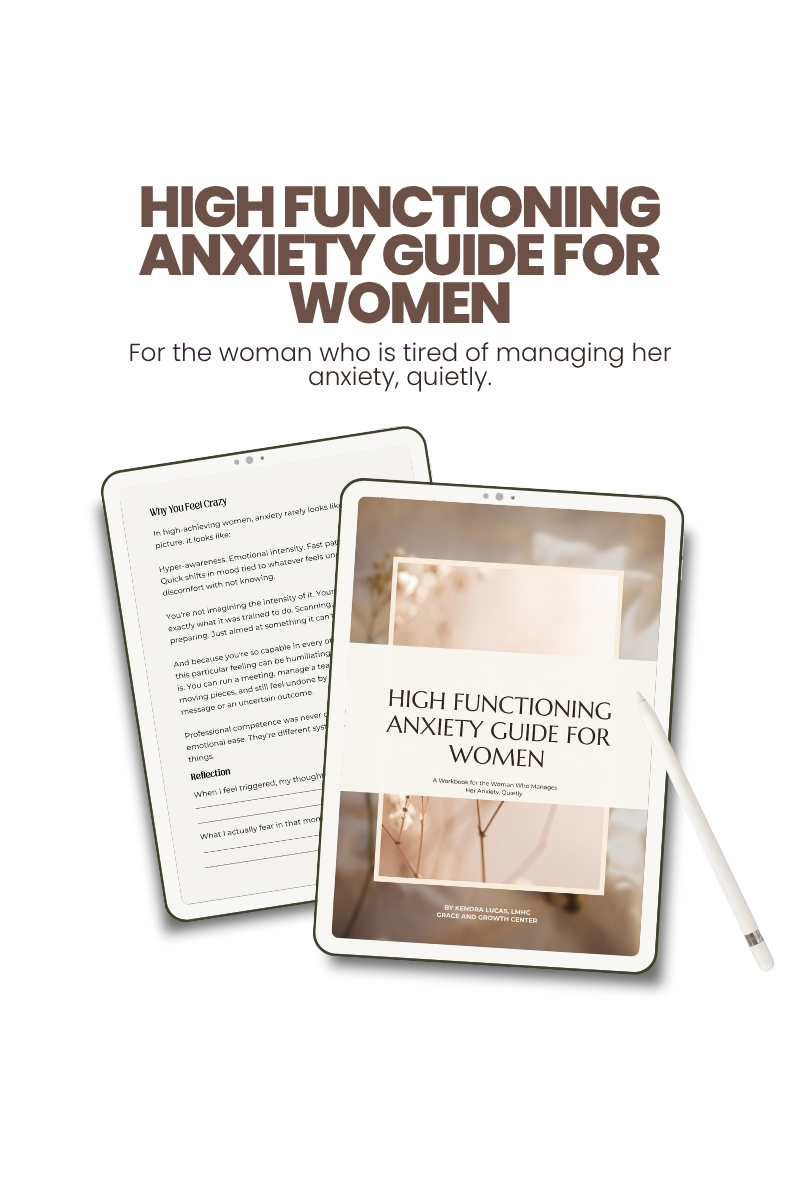
This free guide helps you recognize the difference between productive anxiety and the kind that's quietly running your life, so you can start responding to it instead of just managing it.
What your nervous system is actually asking
When you find yourself unable to make even a straightforward decision, should I go, should I send it, should I say something, your body isn't actually looking for the right answer. It's asking a different question entirely.
Will I be okay, no matter what I choose?
And until something inside you can answer yes to that, the analysis continues. You keep turning the decision over not because you haven't found the right answer yet, but because the part of you that needs reassurance hasn't gotten it. More information won't give it. More scenarios won't give it. The loop doesn't end because you've finally thought it through enough.
It ends, slowly, over time, when you build enough trust in yourself that the question changes. When will I be okaystops being about choosing correctly and starts being about knowing you'll support yourself whatever happens.
The shift that actually helps
When you're in a spiral, trying to find the right answer is usually what keeps you stuck. The question is too big, too loaded, too contingent on things you can't control.
A more useful question: which option feels like I can live with myself afterward?
Not the option that guarantees a perfect outcome. Not the one that makes everyone happy. The one where, if it goes sideways, you won't have abandoned yourself in the choosing. The one where you'll be able to look back and say, I chose based on what I actually knew and needed, and I can respect that.
This is a quieter kind of guidance than certainty. But it's more honest, and it's actually available to you.
How trust gets rebuilt
Decision-trust, the ability to choose without spiraling, doesn't come back all at once. It comes back in small, repeated moments.
Every time you make a decision without over-explaining it to the other person. Every time you send the text without revising it into oblivion. Every time you say no, or yes, or I don't know yet, let me think, and then actually let yourself think without catastrophizing, you give your nervous system a small piece of new evidence.
I chose. Something happened. I handled it. I'm still here.
That evidence accumulates. It doesn't erase the old learning overnight, but it gradually builds a counter-narrative, one where choices aren't emergencies, where your instincts can be trusted, where getting something slightly wrong doesn't cost you everything.
Go slowly with this. The goal isn't to stop caring about your decisions. It's to stop treating every one of them like the stakes are existential when they aren't.
You're not healing from indecision. You're healing from unsafety.
The story that you're just bad at decisions, indecisive, an overthinker, too much, is the wrong story. It locates the problem inside a personality trait, and personality traits feel fixed.
The more accurate story is this: you are someone who learned, in real and specific circumstances, that choices weren't safe. And you developed real and specific strategies to manage that. Those strategies made sense once. Now you're in a different chapter, and you're slowly learning that you can trust yourself to choose, not because every choice will be perfect, but because you'll be okay either way.
That's not a small thing to learn. It's some of the most important work there is.
If this pattern is something you're ready to look at more closely. The anxiety around decisions, the hyper-responsibility, the way old experiences are still shaping how you move through your days. Therapy can be a good place to do that. You can learn more about working togetherhere.
And if you want to stay in this conversation, I write weekly in the newsletter about exactly this kind of thing, anxiety, self-trust, the slow work of feeling safe in your own life. Subscribe below.
You might also like: When Your Mind Won't Let Something Go • How to Set Boundaries Without Guilt
KEEP READING
More for the high-achieving woman.


Ready to stop reading about it and actually change it?
Book a free 15-minute consultation — no pressure, no commitment.

High-achieving women are often the last to seek support, even when they're struggling. Here's why it happens and what getting help can actually look like.