

Why High-Achieving Women Are the Last to Ask for Help
This post contains affiliate links. I may earn a small commission at no cost to you. I only recommend products I'd genuinely suggest to a client.

You are so tired.
Not the kind of tired a weekend fixes. Not the kind that sleep touches. This is the tired that's been collecting in your body for years. Quiet and patient, hiding underneath the promotions and the calendar you somehow still manage and the way everyone describes you as "the one who has it together." It lives under all of that. Most people never see it. Some days, honestly, neither do you.
You built this. Not on purpose. But you built it.
Somewhere back there you learned that being capable was the safest thing you could be. That handling it. All of it, quietly, alone, was what made you valuable. Worth keeping around. Worth loving. So you got good at it. So good that now, saying I'm not okay out loud feels almost impossible, even standing in the middle of a life that's screaming it.
So you don't say it.
You book the therapy appointment and cancel it because work needs you more. You buy the journal. You highlight the book. You tell yourself it'll calm down after this project, this season, this one more thing. I've watched that season never come. I've lived it too. The bar for "bad enough to finally ask for help" just keeps moving further away, like it's running from you on purpose.
This is a pattern. And it makes complete sense once you see where it came from.
You learned to be needless before you learned to be a kid
For a lot of high-achieving women, growing up being capable was a personality trait. In homes where feelings didn't get met with softness, being the reliable one, the easy one, the one who never added to the noise, became the way you stayed safe. Achievement got you praise. Need got you distance. So you made a trade, without ever agreeing to it out loud: handle it quietly, and you'll be fine.
That trade didn't end when you grew up. It just followed you. Into the boardroom. Into the relationship where you keep score of everything except your own exhaustion. Into the almost-text you started typing to a friend about how you're really doing, and deleted, because you didn't want to be a burden.
You are allowed to be a burden sometimes. Let that sentence sit for a second.
This rebuilding process also means getting honest about what you. actually want, not just in relationships, but in life. This post goes deeper on that.
Asking for help feels like admitting you failed. It's not.
Here's the lie so many of us carry: if I really had it together, I wouldn't need this. So needing support, a therapist, a friend who asks twice, a room where you don't have to perform, gets filed away as proof something's wrong with you.
That’s legit proof you're a person.
But it's hard to remember that when everyone around you has only ever met the version of you who handles things. Your team relies on you. Your family leans on you. Your friends call you for advice, not the other way around. And somewhere in there, a real fear takes root: what if I show them the other part of me, and they can't hold it?
Let’s not minimize that fear. That fear is the reason so many capable women suffer in complete silence for years.
Start with a simple check-in.
Sometimes the first step isn't doing more. It's understanding what's been weighing you down. Download this free reflection guide to identify the signs of burnout and reconnect with what you need most.
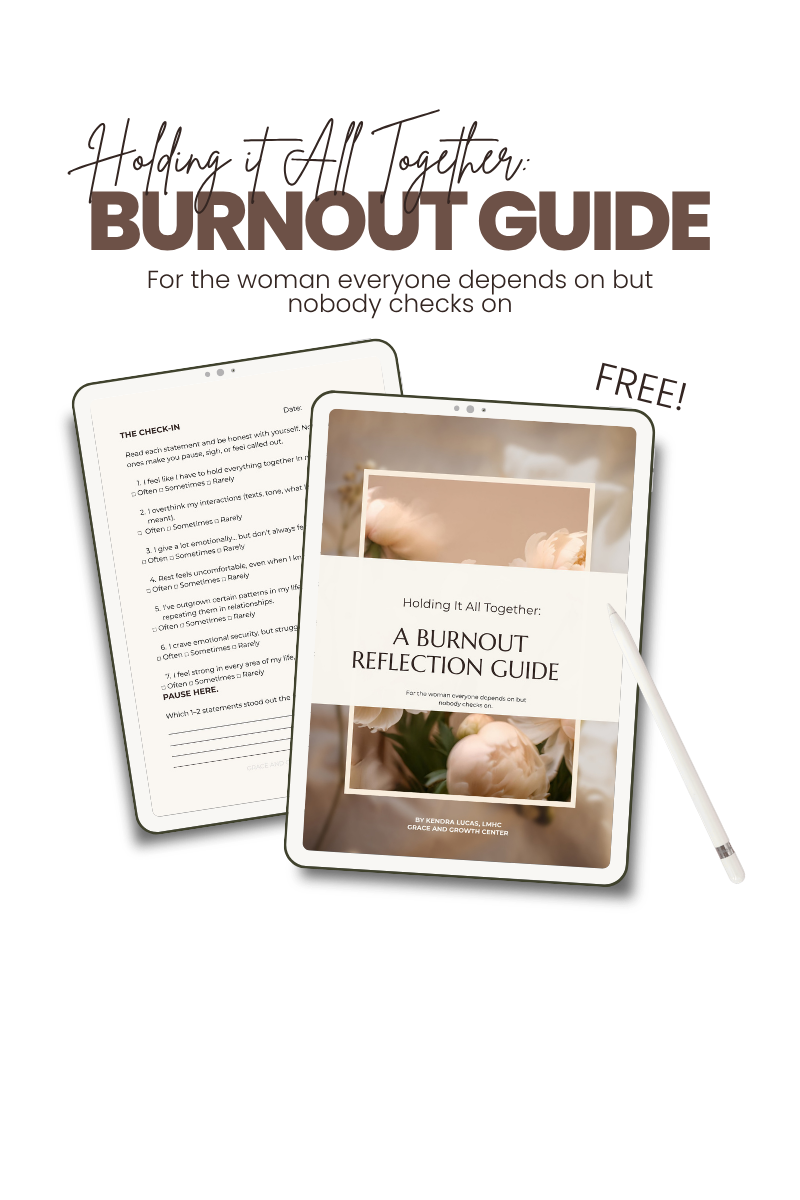
Looking fine is the trap
This is the part nobody warns you about. You can be unraveling, carrying anxiety, grief, burnout, a loneliness you can't name, and still show up early, still hit the deadline, still look like a woman who has it handled. And because nothing visibly breaks, you decide it must not be bad enough yet. You decide you haven't earned the help.
You don't need a breakdown to deserve support.
Feeling like a stranger in your own life is real. Going through the motions of your own relationships while some part of you stays folded up and far away is real. Knowing something is off and not having the language for it is real. Quiet suffering is still suffering. It just doesn't make noise, so it gets ignored the longest, by everyone, including you.
One of the cruelest features of this pattern is that it is largely invisible. But struggle does not require a breakdown to be real. Feeling chronically disconnected from yourself is real. Moving through your own life feeling like an observer rather than a participant is real. Knowing that something is off in the way you relate to the people you love, and not being able to name it or change it, is real. The absence of a rock bottom does not mean the absence of a problem.
It just means the problem is quieter. And quiet problems are often the ones that go unaddressed the longest.
You don't have to earn your way to help. You just have to ask.
Reaching out isn't a white flag. It's not you finally admitting defeat after doing everything else right. It's you recognizing that the tools that got you this far, the hustle, the willpower, the color-coded planner, were never built for the deep stuff. The relational stuff. The stuff underneath the stuff.
You deserve support before you're on the floor. Not after.
The women who've actually found ease, real ease, not the aesthetic of it, didn't get there because they suffered the longest or waited the hardest. They got there because they stopped waiting for permission.
You don't need permission either. You just need to go first.
The women who seem to have figured out the soft life, not the aesthetic, but the actual felt experience of ease and okayness, are not the ones who needed help the least. They are the ones who stopped waiting until they had no other choice. They read the self-help books and buy the journals.
You do not have to wait that long. You are allowed to ask for what you need before you hit a wall. In fact, that is the whole point. That said, reading can still be part of the journey, especially when the books are actually asking the right questions. Here's the list I point women toward.
If you're a woman who can run a company, a household, a whole group chat of people who lean on you, but you still feel completely lost when it comes to your own relationships, I built something for exactly this. My free quiz, Why Do I Have It Together Everywhere — Except Love?, takes a few minutes and hands you language for the pattern you've been living inside without a name for it.
And if some part of you just read all of this and thought, I want to do this work somewhere I don't have to explain myself— good. Stay close. I'm building that room for you right now.
KEEP READING
More for the high-achieving woman.


Ready to stop reading about it and actually change it?
Book a free 15-minute consultation — no pressure, no commitment.

You got close to a goal you used to want and it felt like a stranger's life. Here's why outgrowing your own dream doesn't mean you failed it.