

You Don't Owe Anyone Access to You Just Because They're Used to Having It
This post contains affiliate links. I may earn a small commission at no cost to you. I only recommend products I'd genuinely suggest to a client.

Let me guess.
You said no to something recently. Or you set a limit with someone. And instead of feeling relieved, you spent the next hour, or the next three day, wondering if you were being too much. Too selfish. Too difficult. Too sensitive.
And somewhere in the middle of all that second-guessing, part of you started to quietly negotiate. Maybe you should have just said yes. Maybe you could have handled it differently. Maybe it wasn’t that big a deal.
So you either went back and softened it, or you held the boundary and carried the guilt like a weight you weren’t sure you had the right to put down.
I want to say something directly, because I don’t think anyone has said it to you clearly enough:
Guilt after a boundary is not a sign you did something wrong. It’s a sign your nervous system was trained to keep the peace at the expense of your needs.
Why Saying No Feels Like a Threat
For a lot of the women I work with, especially those who grew up in households where their feelings were too much, where love felt conditional, or where keeping everyone comfortable was somehow their job, saying no doesn’t just feel awkward.
It feels like a threat.
Like something bad is actually going to happen. Like the relationship won’t survive it. Like you’ll lose the person, disappoint them beyond repair, or confirm some deep fear that you’re too much and not enough all at once.
So the guilt isn’t really about the boundary. It’s about an old story, one that taught you your needs were negotiable and everyone else’s weren’t. One that said love had to be earned through availability, compliance, and never asking for too much.
When you understand that, the guilt starts to make a different kind of sense. It’s not a moral signal. It’s a survival response from a younger version of you who learned that keeping the peace was how she stayed safe.
Boundaries don’t just push the right people away. They show you who was only comfortable with you when you were making yourself small.
Disappointing People Is Not the Same as Hurting Them
This is one of the most important distinctions I work through with clients, and I want to offer it to you here:
Disappointing someone is a natural consequence of having needs, values, and limits. It happens in every healthy relationship.
Hurting someone is causing deliberate harm, violating their dignity, or acting out of cruelty. That is something worth examining.
Most of the women I know who struggle with boundaries are not hurting anyone. They are simply refusing to hurt themselves, and the people around them have been conditioned to expect otherwise.
Someone’s discomfort with your boundary is not evidence that your boundary was wrong. It is evidence that they’ve benefited from your lack of one.
Where Boundaries Get the Hardest
In my work, the places women struggle most with boundaries are rarely with strangers. They’re with the people closest to them.
With family, it’s the guilt of feeling like you’re abandoning people who raised you, even when those dynamics are genuinely harmful. With romantic partners, it’s the fear that having needs will make them leave. In toxic co-parenting situations, it’s the exhaustion of trying to hold a line with someone who has never respected one. With emotionally unavailable partners, it’s the hope that if you just stay available enough, patient enough, understanding enough, they’ll finally show up.
All of these are places where the boundary work is slow, nonlinear, and deeply tied to your attachment history. It doesn’t mean the work isn’t worth doing. It means it deserves real support, not just a quote on Instagram.
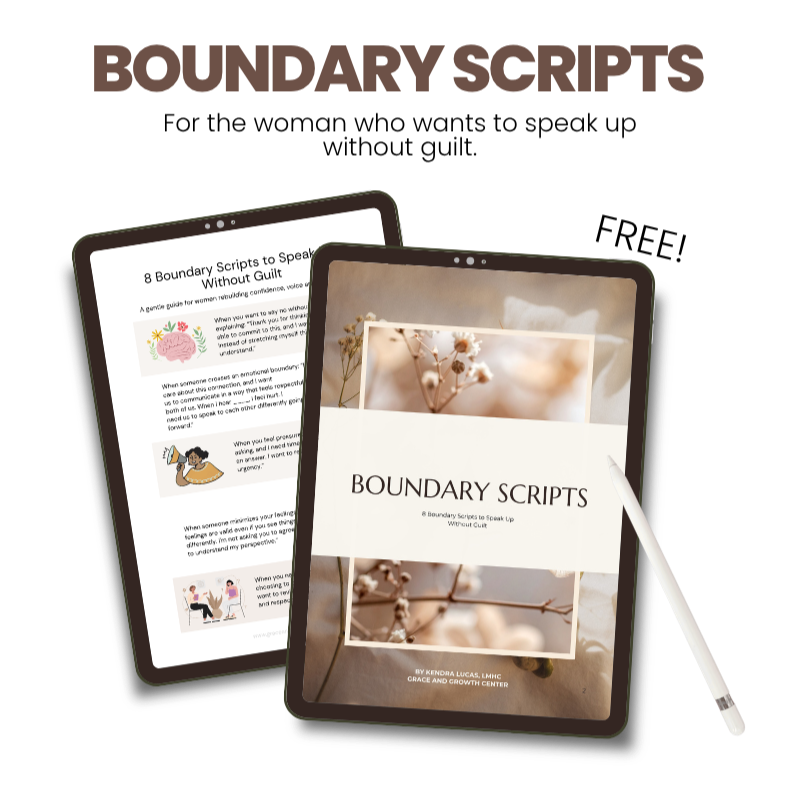
Know What You Need to Say, Just Not How to Say It?
This free guide gives you the exact words for the boundary conversations you keep avoiding, so you can protect your peace without over-explaining yourself.
Why Some Relationships Resist Your Boundaries
Not everyone benefits from your growth. Some relationships were built around your lack of boundaries. Around your overfunctioning. Around your emotional labor. Around your tendency to say yes when you wanted to say no.
So when you begin changing those patterns, it can disrupt the relationship dynamic. That doesn’t necessarily mean the relationship is doomed. Healthy relationships can adapt. But it does mean some people may initially resist the version of you that is no longer abandoning herself to keep the peace.
And honestly? That resistance can reveal a lot. The relationships that are healthiest for you will make room for your honesty, your needs, your limits, and your humanity.
Boundaries Are Not Punishment
A lot of women struggle with boundaries because they think boundaries are about pushing people away. But healthy boundaries are not punishment. They’re communication, clarity, and self-respect.
They help you stay connected to yourself while staying connected to other people. Without boundaries, resentment usually grows quietly in the background. And over time, that resentment can damage relationships far more than honesty ever could.
Three Things to Notice in Yourself This Week
You don’t have to have perfect boundaries to start healing. You just have to start paying attention. Here’s where to look:
When you feel guilty after holding a limit, ask yourself: did I actually do something harmful, or did I just disappoint someone? Sit with the difference. It matters more than you know.
Notice which relationships in your life require you to shrink to keep the peace. That pattern is information, not about your worth, but about the dynamic.
Ask yourself whose comfort you’ve been prioritizing over your own, and for how long. You don’t have to blow up anything today. Just get honest with yourself about the cost.
If you want to actually do this exercise rather than just think about it, here are the journals I recommend for exactly this kind of processing work.
You’re Allowed to Take Up Space
The relationships that can’t survive your honesty were never as safe as they felt. The ones worth keeping will adjust. They might need time. They might push back at first. But the right people, the ones who actually love you, will meet you in your wholeness, not just in your compliance.
If you’re ready to start doing this work with real support, I’d love to be in your corner. Schedule your free consultation →
Journal Prompts for Setting Boundaries
Where in my life do I feel resentful, and what boundary might be missing?
What do I keep saying yes to when I really want to say no?
What am I afraid people will think if I set a boundary?
What relationships leave me feeling emotionally drained?
Where have I confused love with self-sacrifice?
What boundary would make the biggest difference in my life right now?
Who makes me feel like I have to over-explain myself?
What does respect look like in my relationships?
What am I no longer willing to tolerate?
What needs have I been ignoring?
Where do I need more space to breathe?
What would protecting my peace look like this week?
What boundary have I been waiting for someone else to give me permission to set?
How do I want people to experience me moving forward?
What does choosing myself look like today?
KEEP READING
More for the high-achieving woman.


Ready to stop reading about it and actually change it?
Book a free 15-minute consultation — no pressure, no commitment.

Feelings are information, not instructions. Here's how to take your emotions seriously without letting them run every decision.