

How to Spot Burnout Before It Spirals Out of Control
This post contains affiliate links. I may earn a small commission at no cost to you. I only recommend products I'd genuinely suggest to a client.

Burnout doesn't announce itself. It doesn't arrive on a Tuesday with a clear diagnosis and a plan of action. It seeps in slowly, wearing the costume of a busy season, a hard week, a temporary stretch that keeps somehow extending. By the time most women recognize it for what it is, they've already been in it for months.
That's not a failure of awareness. It's just how burnout works, especially for high-achieving women who are skilled at pushing through, normalizing discomfort, and telling themselves things will calm down soon.
They don't. Not on their own.
The good news is that your body and mind will almost always signal what's happening before it becomes a full crisis. Learning to read those signals, and take them seriously, is one of the most protective things you can do for yourself.
The Early Signs Worth Paying Attention To
Fatigue that sleep doesn't touch. This is usually the first sign, and the easiest to dismiss. You slept eight hours and woke up exhausted. You've been tired for so long it's started to feel like your personality. When rest stops being restorative, your nervous system is telling you that the problem isn't the amount of sleep — it's the chronic depletion underneath it. If you want support on the supplement side, ashwagandha is one of the more well-researched adaptogens for stress-related fatigue and is worth exploring with your doctor.
Emotional flatness or detachment. Not sadness exactly — more like numbness. Conversations that should feel meaningful start feeling like tasks. You go through the motions with people you love and come away feeling nothing, or worse, more drained than before. This emotional distance is one of burnout's quieter symptoms, and one of the most disorienting. A guided journal can be a gentle way back in — not to process everything at once, but to start noticing what you're actually feeling beneath the flatness.
Concentration that keeps slipping. You sit down to work and the focus just isn't there. You reread the same paragraph three times. You start tasks and lose the thread. Cognitive fog is a real and documented symptom of burnout, and it tends to compound the stress — because now you're behind, and you're also struggling to catch up, which accelerates the depletion.
Irritability that feels out of proportion. Small things hitting hard. Patience that used to come easily now feels like it costs something. If you've noticed yourself snapping at people you care about, or feeling a low simmer of frustration that doesn't have one clear source, that's worth paying attention to. It's not a character flaw — it's a tank running on empty.
Physical symptoms that keep appearing. Headaches. Tension in your neck and shoulders that won't release. Stomach issues. Disrupted sleep. The body keeps score in very literal ways, and chronic stress has physical consequences. A weighted blanket sounds small, but for nervous system regulation at the end of a long day, the research on pressure and anxiety reduction is genuine — it's one of those low-lift tools that actually helps.
For a deeper look at how these symptoms connect and what they mean together, the post on burnout versus laziness goes into the full picture — including the Christina Maslach framework that's actually useful for understanding what stage you're in.
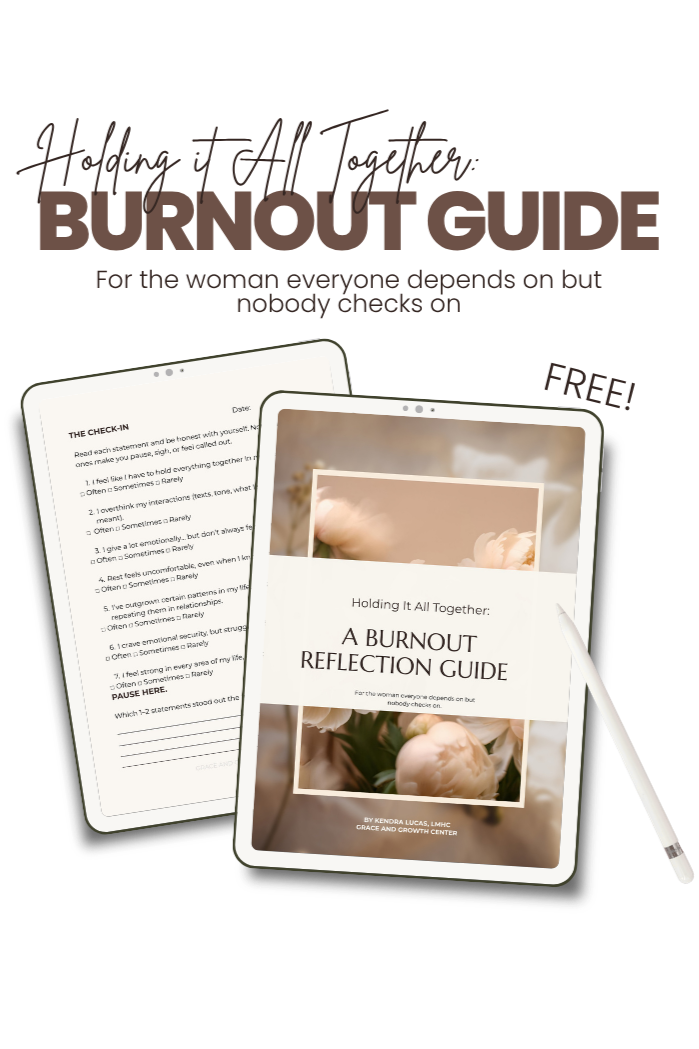
Feeling Like You're Holding Everything Together?
This free guide includes 5 powerful prompts to help you identify what's draining you, where you're carrying too much, and what needs your attention right now.
What Actually Helps Before It Becomes a Crisis
The instinct when you recognize burnout is often to optimize — to find the right productivity system, the right morning routine, the right supplement stack. And while some of those things have real value, they don't address the root. Real prevention means looking at the patterns, not just the symptoms.
Rest has to become non-negotiable, not aspirational. This means protecting sleep, yes, but also protecting the space between tasks, the evenings that aren't scheduled, the weekends that don't become catch-up time. If you want data to motivate the habit, a sleep tracking device can help you see concretely what's happening to your rest quality — sometimes seeing the numbers makes it easier to take seriously.
Boundaries are the structural piece. Without them, every other self-care practice is just patching a leak in a sinking boat. Nedra Tawwab's Set Boundaries, Find Peace is the book I recommend most often on this, it's practical, warm, and written for real life rather than theory. The work of actually holding limits is hard, but it's also where the real recovery begins.
Movement matters, even when it's gentle. When burnout is deep, the idea of exercise can feel like one more thing being demanded of your already depleted body. But gentle movement, stretching, walking, beginner yoga, isn't about fitness. It's about giving your nervous system a way to discharge the tension it's been holding. A beginner yoga kit is a genuinely low-barrier way to start if you're not someone who currently has a movement practice.
Mindfulness over more hustle. A short, consistent mindfulness practice — even five to ten minutes — has measurable effects on the stress response over time. Headspace is one of the more accessible apps for this, and pairing it with a meditation cushion that makes the practice feel intentional rather than squeezed in can help it actually stick.
Therapy for the patterns underneath. Tools help. Supplements help. Sleep helps. But burnout that keeps recurring — the kind where you recover briefly and then crash again — is almost always connected to something structural: beliefs about your worth, difficulty asking for help, an identity that's been fused with productivity for so long that rest genuinely feels threatening. That's the work that therapy is designed for, and it's the piece that makes the lasting difference. You can learn more about what that looks like at Grace and Growth Center.
A Note on Catching It Early
The version of burnout that's caught in the early warning stages is so much easier to work with than the version that's been ignored for a year. You don't have to be in crisis to deserve support. You don't have to have completely lost yourself to start paying attention.
If you recognized yourself anywhere in this post, that recognition is the beginning. Your nervous system has been sending signals, this is you finally listening.
Download the free burnout resource below to start getting clearer on where you are and what you need next.
Journal Prompts for Women Learning to Rest
What emotions come up when I try to slow down?
When did I start believing I had to earn rest?
What am I afraid will happen if I stop being productive?
What does my body need from me today?
What does true rest feel like—not distraction, but restoration?
What part of my identity is tied to being busy?
What would I do if I didn't feel guilty for taking a break?
How do I know when I'm emotionally exhausted?
What am I trying to outrun by staying busy?
What expectations can I release today?
What would I say to a friend who felt guilty for resting?
Where in my life have I confused productivity with worth?
What would enough look like for today?
How can I care for myself with the same compassion I offer everyone else?
What kind of life am I creating when I make room for rest?
KEEP READING
More for the high-achieving woman.


Ready to stop reading about it and actually change it?
Book a free 15-minute consultation — no pressure, no commitment.

You got close to a goal you used to want and it felt like a stranger's life. Here's why outgrowing your own dream doesn't mean you failed it.