

Burnout Isn't a Trend. For High-Achieving Women, It's a Slow Emergency
This post contains affiliate links. I may earn a small commission at no cost to you. I only recommend products I'd genuinely suggest to a client.

Burnout is having a moment in the cultural conversation. But for high-achieving women, it's not a trend. It's a slow emergency that's been building for years.
Women in demanding careers are burning out at higher rates than their male counterparts. They're doing more, at work and at home, with less acknowledgment, less structural support, and a cultural narrative that tells them resilience is a personal virtue, not a systemic failure.
The result is a generation of capable, driven women who are utterly depleted and deeply confused about why.
What's actually driving it
Burnout isn't just about working too much, though that's part of it. Research from Christina Maslach, one of the foremost burnout researchers, identifies six key mismatches that lead to burnout: workload, control, reward, community, fairness, and values. You can burn out even in a job you love if the environment is chronically unfair or your values keep getting compromised.
For high-achieving women specifically, there are compounding factors. The emotional labor of navigating workplaces that weren't designed with them in mind.
The second shift of domestic and relational responsibilities that doesn't pause when work is intense. The internal pressure to perform not just competently but exceptionally, because mediocrity feels like failure.
Add to that the perfectionism, the tendency to over-function and under-ask for help, and the stoicism that says you should be able to handle this, and you have a recipe for a very specific kind of collapse.
If the over-functioning piece resonated, these are some of the resources I recommend for women starting to understand that pattern.
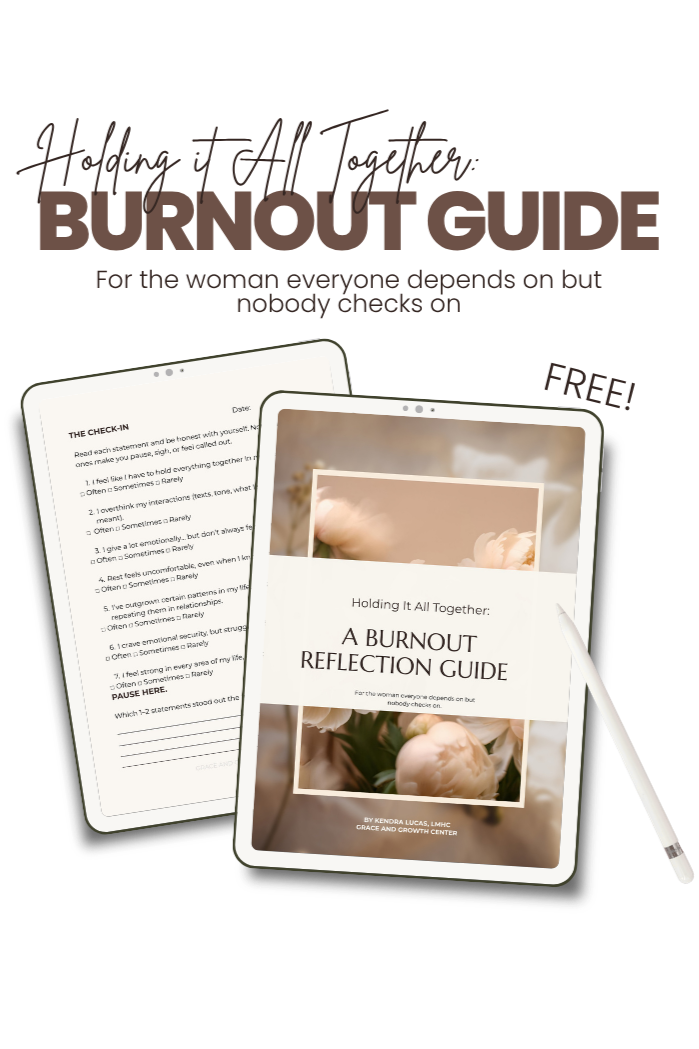
Not Sure If You're Burnt Out — Or Just "Tired"?
This free guide helps you spot the difference between needing a nap and needing an actual reset, so you know what your body is really asking for.
Why high achievers miss the signs
One of the cruelest ironies of burnout is that the same traits that make someone a high achiever, drive, persistence, high standards, also make her terrible at recognizing burnout in herself.
She pushes through fatigue because she always has. She dismisses irritability as stress. She chalks up the loss of joy to needing a vacation. She tells herself she'll rest 'after this project,' and then after the next one.
By the time most high-achieving women seek help for burnout, they're not just tired. They're experiencing cognitive symptoms (difficulty concentrating, memory issues), physical symptoms (sleep disruption, immune suppression, GI problems), and emotional symptoms (numbness, cynicism, a deep sense of meaninglessness).
The recovery nobody talks about
Burnout recovery is not a long weekend. It's not a spa day. And it's definitely not just 'taking a break' while everything waits for you to return stronger.
Real recovery requires addressing the patterns and beliefs that made burnout possible in the first place, the difficulty saying no, the over-responsibility, the identity wrapped up in productivity, the inability to rest without guilt.
Without that inner work, most high achievers recover just enough to start burning out again. This is something I write about more in this post, the difference between achieving and actually feeling like enough.
Therapy is one of the most effective tools for burnout recovery precisely because it's not a surface-level fix. It helps you understand how you got here, what needs to change, and how to build a relationship with yourself and your work that is sustainable.
Journaling is one of the tools I return to with clients in burnout recovery, here's what I actually recommend.
Houston's unique pressure cooker
There's something particular about burnout in Houston. This is a city that celebrates hustle. The culture here, in medicine, law, energy, finance, entrepreneurship, often treats overwork as a badge of honor. Taking care of yourself can feel like falling behind.
But the women showing up to therapy for burnout in Houston aren't weak. They're the most driven people in the room who finally got honest about the cost of what they were carrying.
Burnout doesn't mean you're broken. It means something has to change.Burnout therapy for women in Houston can help you recover and rebuild in a way that actually lasts.
Burnout doesn't only happen at work. Many of my clients are also carrying this kind of depletion in their relationships, here's what that can look like.
Journal Prompts for Emotional Burnout
What is currently draining my emotional energy?
What have I been ignoring about my limits?
What feels heavy even when nothing is “wrong”?
Where am I operating on autopilot?
What am I pushing through that I need to pause for?
What emotions have I not processed yet?
What would rest actually look like for me right now?
What am I carrying for others emotionally?
What do I need support with?
What would I stop doing if I listened to my body?
What is my nervous system trying to tell me?
What feels overwhelming but unspoken?
What expectations can I release?
What would it mean to fully slow down?
What do I need to recover, not just function?
KEEP READING
More for the high-achieving woman.

Ready to stop reading about it and actually change it?
Book a free 15-minute consultation — no pressure, no commitment.

Emotional burnout in high-achieving women doesn't always look like a breakdown. Learn why you might be depleted without knowing it, what it's quietly costing you, and where to start feeling like yourself again. Written by a licensed therapist.