

What to Buy Yourself Instead of Texting Your Ex (A Therapist's Breakup Recovery List)
This post contains affiliate links. I may earn a small commission at no cost to you. I only recommend products I'd genuinely suggest to a client.

You've picked up your phone three times in the last hour. You haven't texted. That's growth.
But you're still sitting in the middle of a feeling that has no clean edges, not quite sad, not quite okay, and definitely not able to focus on anything requiring actual brain function. You've cried. You've journaled. You've called your best friend. And now you're just... here. In the ache.
Here's what I want you to know as a therapist who works with women going through exactly this: the early days of a breakup are not the time to be productive. They're the time to survive with softness. Your nervous system has taken a real hit. The goal right now is regulation, warmth, comfort, sensory grounding, not optimization.
So instead of texting them, here's what I want you to buy yourself.
The Breakup Recovery Kit: Things That Actually Help
I put together an Amazon list of everything I'd recommend to a client walking through a fresh breakup. These aren't gimmicks. Each one serves a real purpose in helping your body and mind come back to baseline.
A Weighted Blanket
This is one of the most underrated tools for nervous system regulation. The deep pressure from a weighted blanket activates your parasympathetic nervous system, which is the part responsible for calming you down. When everything in your emotional world feels unstable, something heavy and grounding on your body sends a signal to your brain that you are safe. Get in it. Stay there as long as you need.
A Candle With a Scent You Love
Smell is the sense most directly tied to the emotional centers of your brain. Lighting a candle isn't just ambiance, it's an anchor. It tells your nervous system this space is calm, this moment is mine. Pick something warm and grounding: vanilla, sandalwood, amber. Make it yours, not a scent that reminds you of them.
Electrolyte Water
Nobody talks about this, but crying is physically depleting. So is stress. So is the cortisol spike your body has been running on since the breakup. Electrolyte water replenishes what your body is losing and helps with the fatigue, brain fog, and headaches that often follow emotional distress. Hydration is not a small thing when you're grieving.
A Comfort Tea
There is something deeply regulating about wrapping your hands around a warm mug. Chamomile, ashwagandha blends, or sleepytime teas can gently support your nervous system and signal to your body that it's time to slow down. Make it a ritual, not just a drink.
A Breakup Recovery Workbook
This is where the real work lives. A guided workbook gives your thoughts somewhere to go when they're too scattered for free journaling but too intense to just ignore. Look for ones focused on attachment, self-worth, or identity — not just "healing your heart" platitudes, but actual reflection prompts that help you understand what happened and what it meant for you.
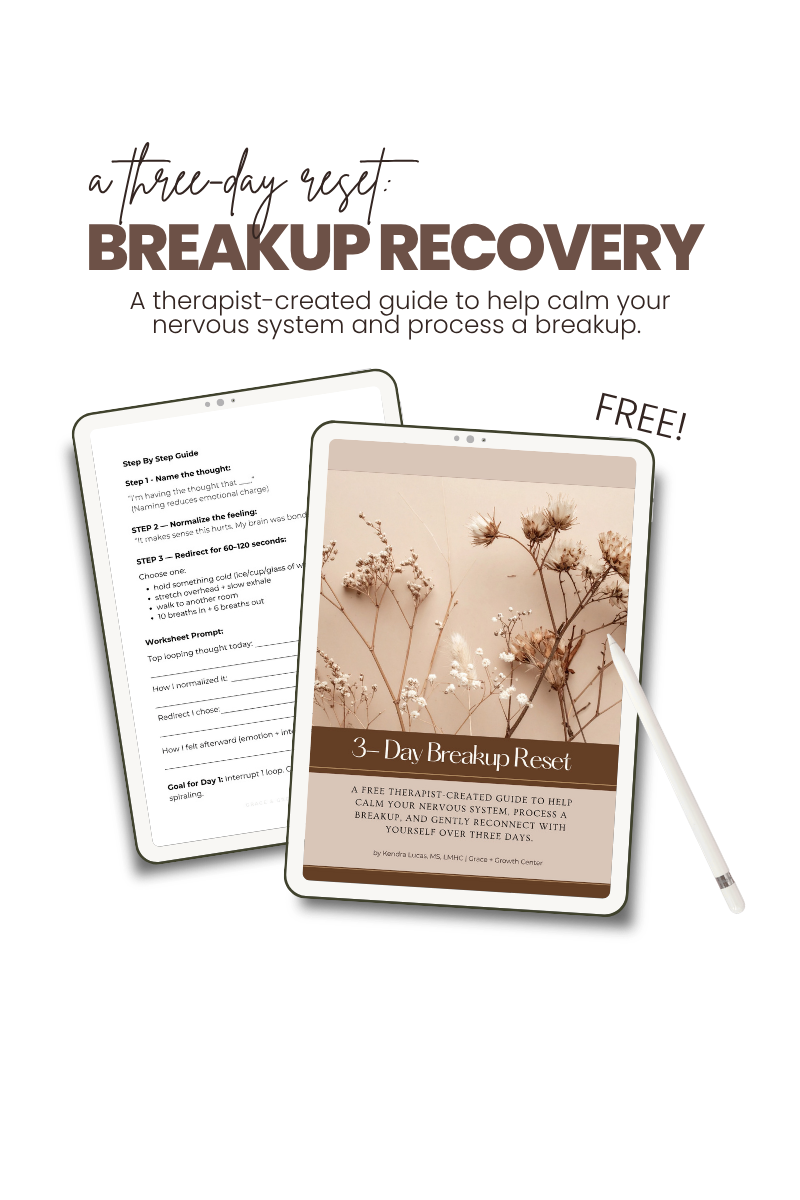
Trying to Heal From a Breakup That Still Doesn't Make Sense?
This free guide walks you through the questions you're still asking yourself, so you can start making sense of what happened and start feeling like you again.
A Journal
Unstructured journaling is different from a workbook, and you need both. Some nights you won't want prompts, you'll just need to empty your brain onto a page. A beautiful journal (not just a plain notebook) makes that feel like an act of care rather than homework. You're worth the nice one.
Cozy Socks
I know this sounds small. It isn't. Physical warmth and comfort are not luxuries during grief, they're regulation tools. Soft, warm socks are a tiny way of taking care of your body when your emotions feel too big to manage. Put them on. Let it count.
A Sleep Mask
Sleep is one of the first things to go after a breakup, and one of the most important things to protect. A good sleep mask blocks light, signals your brain that it's time to rest, and creates a small sensory cocoon for your nervous system at the end of a hard day. Pair it with your comfort tea and make a wind-down ritual out of it.
Shower Steamers
When you can't take a bath and you need a reset, shower steamers are it. Eucalyptus and lavender varieties in particular activate the calming branch of your nervous system through your breath. Stand in the steam. Breathe slowly. Let your body decompress in real time.
A Soft Plushie
Before you scroll past this one, hear me out. Touch is a primary way humans self-soothe. It's not childish to want something soft to hold. It's biological. If a plushie feels like too much, a super soft pillow does the same thing. The point is having something in your hands and against your body that communicates comfort to your nervous system.
Adult Coloring Books
This might be the most underrated item on the entire list. When your mind won't stop racing, you need an activity that occupies your hands and requires just enough focus to quiet the noise, but not so much that it becomes stressful. Coloring is meditative, repetitive, and genuinely calming. It's not a childish coping mechanism. It's a legitimate emotional regulation tool that happens to also be pretty.
A Note Before You Add to Cart
None of these things will fast-forward the grief. The ache has its own timeline, and that's actually okay, it means you loved something real. But these tools can make the process feel less like you're white-knuckling through it alone.
Your nervous system is working hard right now. Let these things work with it.
And if you find yourself in the same patterns again and again, ending up in relationships that leave you feeling anxious, unseen, or confused about what went wrong, that's worth exploring in a deeper way. Sometimes a breakup recovery kit helps you survive the season. Therapy helps you change the story.
Shop the full Breakup Recovery Kit on Amazon →
If this landed for you, forward it to a friend who needs it. And if you're ready to go deeper, you can learn more about working together here.
KEEP READING
More for the high-achieving woman.


Ready to stop reading about it and actually change it?
Book a free 15-minute consultation — no pressure, no commitment.

Some endings never come with an explanation. Here's how to stop waiting for one and give yourself the closure you never got.