

Why Overthinking Ruins Relationships (And How to Finally Stop)
This post contains affiliate links. I may earn a small commission at no cost to you. I only recommend products I'd genuinely suggest to a client.

You're lying awake at 2am replaying a conversation from three days ago. You've drafted a text seventeen times and still haven't sent it. You know, logically, that things are probably fine, but your brain refuses to accept that and keeps running scenarios.
Welcome to overthinking in relationships. It's one of the most common things people bring to therapy, and one of the most misunderstood.
Here's what's important to know: overthinking isn't a personality flaw. It's not a sign that you're crazy or too much or difficult. It's a symptom, usually of anxiety, and often of something that happened long before this relationship.
If the relationship itself feels like the source of the anxiety, not just your reaction to it, this post might help you get clearer on what you're actually dealing with
What overthinking is actually doing
Overthinking feels like problem-solving, but it isn't. Real problem-solving moves toward resolution. Overthinking is circular, it rehearses threats, analyzes ambiguity, and searches for certainty in situations that are inherently uncertain.
Your brain is trying to protect you. If you can just think hard enough, maybe you can prevent something bad from happening. Maybe you can figure out what he really meant. Maybe you can predict whether this is going to hurt you so you can prepare.
The problem is that this protection system is misfiring. Instead of keeping you safe, it's keeping you stuck, exhausted, disconnected, and unable to be present with the person in front of you.
The reassurance-seeking cycle
One of the ways overthinking shows up most visibly in relationships is through reassurance-seeking. You ask if they're okay. They say yes. You feel better for about eleven minutes, and then the anxiety creeps back in and you need to ask again.
This isn't a willpower problem. It's a cycle, and it has a structure. The anxiety spikes, the reassurance temporarily relieves it, and your brain learns that asking is how you manage the feeling. So the next time anxiety spikes, and it will, because the underlying pattern hasn't changed, the urge to seek reassurance is even stronger.
Over time, this creates a dynamic where your partner becomes responsible for regulating your emotional state, which isn't fair to them and doesn't actually work for you. The relief is always temporary because reassurance can't fix what's driving the anxiety in the first place. It just keeps the cycle running.
What makes this particularly painful is that it often pushes away the very closeness you're trying to protect. Partners who love you can still become worn down by the constant need for confirmation. And the more they pull back, the more your anxiety escalates, and the more reassurance you need. It's a loop that tightens over time if the root cause is never addressed.
How it damages relationships
Chronic overthinking erodes relationships in several ways. First, it creates emotional distance. When you're stuck in your head, you're not actually with your partner. You're in a simulation of the relationship, running worst-case scenarios, while the real person is left wondering where you went.
Second, it generates conflict. Overthinking often leads to seeking reassurance, asking 'are you sure you're not mad at me?' for the fifth time, interpreting a short text as withdrawal, picking fights to test whether someone will stay. Over time, this wears partners down.
Third, it prevents real intimacy. Intimacy requires uncertainty, you have to be willing to not know how this is going to turn out. Overthinking is an attempt to eliminate that uncertainty, and in doing so, it eliminates the vulnerability that makes real closeness possible.
This kind of mental exhaustion doesn't stay in the relationship. For a lot of high-achieving women, it shows up everywhere, here's what that can look like.
Where it usually comes from
Most people who overthink in relationships didn't develop this in their current relationship. They developed it earlier, in a family where things were unpredictable, where love was conditional, where conflict was scary, or where attachment was inconsistent.
When your early experiences taught you that the people closest to you were unreliable or dangerous, your nervous system learned to stay alert. Hypervigilance in relationships, scanning for signs of rejection, reading into tone of voice, needing to analyze everything, was adaptive once. It kept you safe.
What I'm describing here, the hypervigilance, the scanning, the need to analyze everything, has a name, and it usually has roots. If this section resonated more than you expected, these are some of the resources I recommend for women starting to understand their attachment patterns. Browse the Anxious Attachment Healing Starter Pack →
But those old survival strategies don't serve you in adult relationships with people who are actually safe. They just keep creating the instability you're trying to prevent.
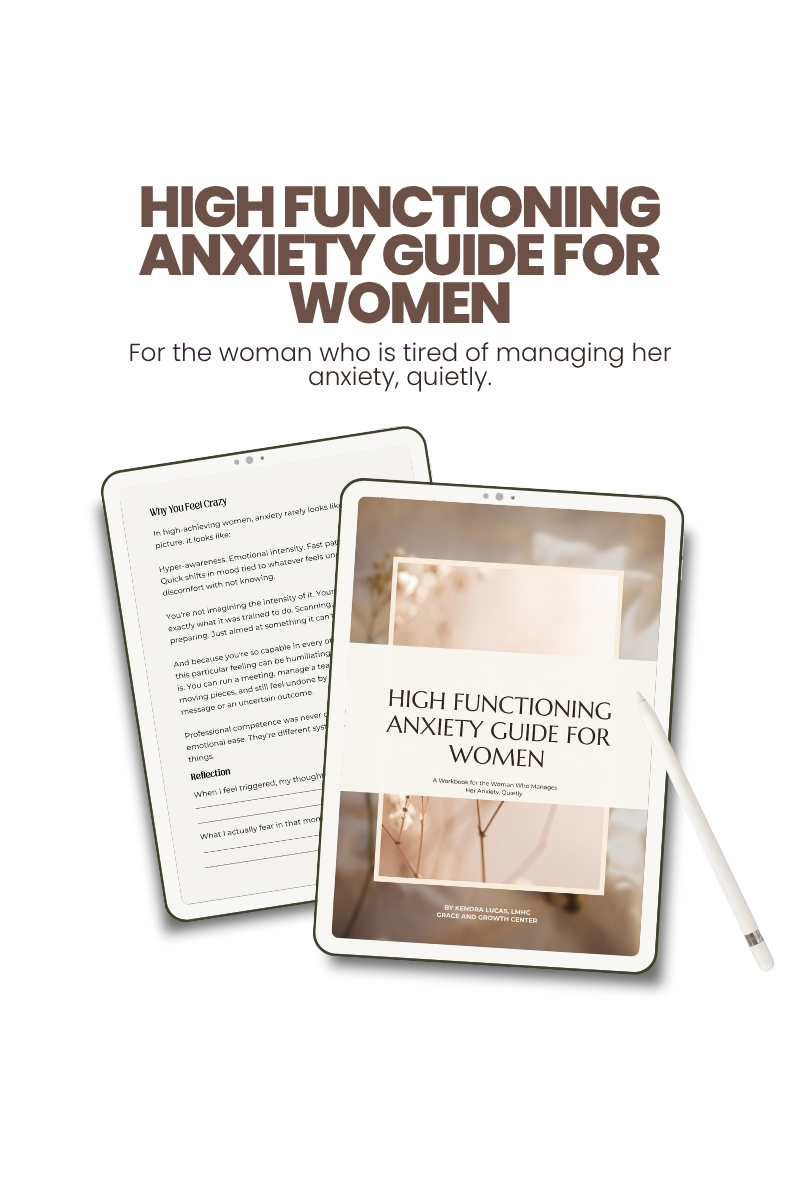
Is Your Anxiety Just... How You Function Now?
This free guide helps you recognize the difference between productive anxiety and the kind that's quietly running your life, so you can start responding to it instead of just managing it.
Is it anxiety or is it intuition?
This is one of the most common questions I hear from women working through overthinking in relationships, and it's worth taking seriously because the answer actually matters.
Anxiety and intuition can feel identical in the body. Both show up as a sense that something is off. Both create urgency. Both feel like important information you shouldn't ignore. So how do you tell the difference?
Intuition tends to be quiet and specific. It doesn't spiral. It doesn't need you to replay the same conversation seventeen times to make its point. It usually lands as a clear, calm knowing, even when what it's telling you is uncomfortable. You feel it and then it settles.
Anxiety is loud and repetitive. It generates more questions than answers. It catastrophizes. It needs evidence, then more evidence, then finds a reason why the evidence isn't enough. It doesn't settle, it escalates.
The honest truth is that when you have a history of anxious attachment, your alarm system is calibrated to a threat level that doesn't match your current reality. That doesn't mean your gut is always wrong. It means it's worth learning to distinguish between the signal and the noise, and that's some of the most valuable work you can do in therapy.
If something genuinely isn't right in your relationship, you deserve to know that clearly, not through a fog of anxiety. Getting your nervous system regulated enough to hear your actual intuition is part of what healing looks like.
What it actually looks like day to day
Because it's worth naming concretely: this is what overthinking in a relationship can look like on an ordinary Tuesday.
He takes forty minutes to respond to a text and your mood shifts entirely. You go back and read your last message three times trying to figure out what you said wrong. By the time he responds normally, you've already mentally rehearsed a version of the conversation where he tells you he's pulling away. You feel relieved when you see his message, then immediately embarrassed that you spiraled, then anxious about whether the spiraling itself is a problem.
Or: you had a good night together, but on the drive home you start dissecting it. Was he quieter than usual? Did that comment mean something? You replay it looking for evidence of a problem, and by the time you get home, what was a perfectly good evening has been quietly dismantled by your own mind.
This is exhausting in a way that's hard to explain to someone who doesn't experience it. You're not choosing to do this. You're not being dramatic. Your brain is genuinely working overtime, trying to keep you safe from something it perceives as dangerous. The problem is that the threat it's responding to lives in the past, not in your actual relationship.
What actually helps
Willpower doesn't fix overthinking. Neither does telling yourself to just stop. If it were that simple, you would have stopped already.
What actually moves the needle is working with your nervous system instead of against it. A few places to start:
Notice the spiral before you're in it. Overthinking has a texture you can learn to recognize early, a particular quality of mental restlessness, a pull toward your phone, a shift in your body. The earlier you catch it, the easier it is to interrupt. You're not trying to stop the thought. You're trying to notice that the spiral has started so you can make a choice about what you do next.
Name what you're actually feeling underneath the thought. Overthinking is almost always covering a feeling, usually fear, sometimes grief, sometimes shame. The thoughts are your brain's attempt to do something with that feeling. When you can get underneath the thought to the actual emotion and name it, I'm scared he's losing interest, I'm afraid I'm too much, I'm grieving how this used to feel, the urgency of the spiral usually softens a little.
Delay reassurance-seeking deliberately. Not forever. Just long enough to let the anxiety peak and come down on its own, even slightly. Every time you tolerate a small amount of uncertainty without immediately reaching for relief, you're building evidence that you can survive the not-knowing. That evidence accumulates.
Work with someone who understands attachment. These patterns didn't develop in this relationship and they won't resolve in it either. Therapy, particularly approaches that address anxiety and attachment at the root, can help you trace where this started, understand what it's been protecting you from, and build a new relationship with uncertainty that doesn't cost you your presence or your peace.
The goal isn't to stop caring about your relationships. It's to stop letting anxiety run them.
One of the ways I support clients in building that capacity to sit with uncertainty is through reflective writing, not to analyze more, but to discharge the loop and come back to the body. These are the journals I recommend. See the list →
If overthinking is getting in the way of the relationships you want, this postcan help you find your way back to presence, trust, and genuine connection.
If you want to go deeper on where this comes from and what healing actually looks like, here's the reading list I point women toward. Browse the list →
10 journal prompts when you're overthinking your relationship
Don't answer these based on what you hope is true. Answer them based on what you actually experience.
What specifically am I afraid is going to happen?
What evidence do I have for that fear?
What evidence do I have against it?
Am I reacting to something happening now or something that happened before?
What do I need from my partner that I'm afraid to ask for?
What does emotional safety look like for me?
What am I assuming instead of communicating?
If I trusted myself completely, how would I handle this?
Am I trying to get certainty where certainty isn't possible?
What would I tell my best friend if she described this exact situation to me?
KEEP READING
More for the high-achieving woman.


Ready to stop reading about it and actually change it?
Book a free 15-minute consultation — no pressure, no commitment.

High-achieving women are often the last to seek support, even when they're struggling. Here's why it happens and what getting help can actually look like.