

The Best Journals for Healing Anxious Attachment — A Therapist's Picks
This post contains affiliate links. I may earn a small commission at no cost to you. I only recommend products I'd genuinely suggest to a client.

I believe in journaling the way some therapists believe in meditation as a non-negotiable practice for women doing real healing work.
But I want to be honest with you about something: unstructured journaling after a heartbreak or during an anxiety spiral can sometimes make things worse, not better. When you sit down with a blank page and no direction, the anxious mind tends to do what it always does, replay, analyze, ruminate. You end up spending forty-five minutes relitigating a conversation from three weeks ago instead of actually processing anything.
The right journal changes that. A good journal gives your thoughts a container, moves you through the grief or anxiety in a productive direction, and builds the kind of self-awareness that actually translates into different behavior in your relationships.
After years of recommending journaling tools to my therapy clients, these are the ones I return to most.
Why Journaling Works for Anxious Attachment Specifically
Anxious attachment lives partly in the prefrontal cortex, the part of your brain responsible for overthinking, planning, and anticipating, and partly in the body as stored nervous system activation. Journaling works on both levels.
Writing externalizes the anxious inner monologue. It gets the spiral out of your head and onto a page where you can see it clearly rather than feel it endlessly. Research on expressive writing consistently shows reductions in anxiety, improved emotional processing, and greater psychological clarity, all of which are directly relevant to attachment healing work.
For the body piece, somatic journaling prompts, ones that ask you to notice and name physical sensations alongside thoughts, help build the mind-body connection that nervous system healing requires.
Here are the journals that do this work best.
The Journals
For understanding your relationship patterns:
Becoming the One: A Guided Journal: Mend Your Relationship Patterns and Reclaim Your Self → This journal is specifically designed for women examining their patterns in love. The prompts move through childhood experiences, relationship history, recurring dynamics, and current beliefs about love and worthiness. It's the closest thing to guided self-therapy I've found in journal form. I recommend this one most to clients who are between therapy sessions and want structured reflection work to do on their own. Get it here
"The Attachment Theory Workbook" by Annie Chen → Part journal, part workbook, this one walks you through the clinical framework of attachment theory and then gives you prompts and exercises to apply it directly to your own relationships. It bridges understanding and application in a way that most books don't. Particularly useful if you're the kind of woman who needs to understand the why before she can do the work. Get it here
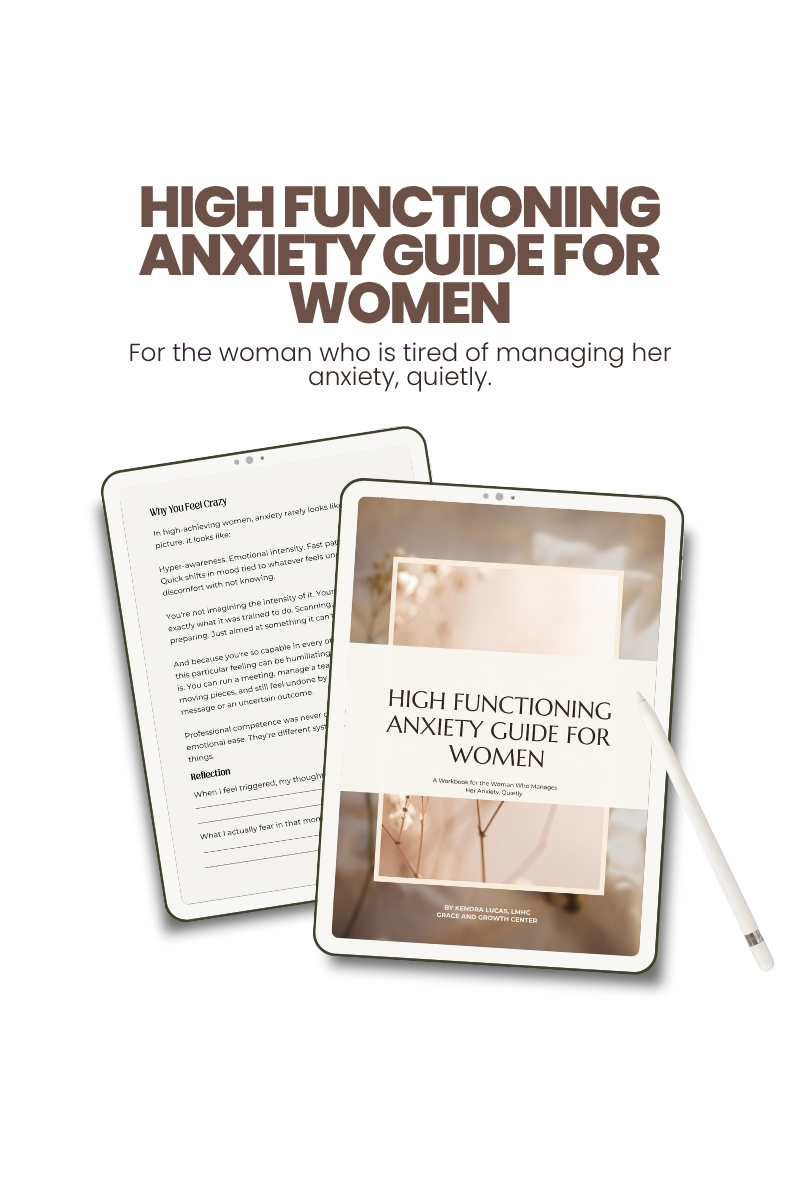
Is Your Anxiety Just... How You Function Now?
This free guide helps you recognize the difference between productive anxiety and the kind that's quietly running your life, so you can start responding to it instead of just managing it.
For processing grief and heartbreak:
Forget You Not: A Guided Grief Journal & Keepsake for Navigating Life Through Loss→ Grief needs somewhere to go. This journal provides structured prompts for moving through the stages of relationship grief, the anger, the bargaining, the moments of clarity, the setbacks. Having a container for the grief rather than just a blank page makes the processing more intentional and less likely to spiral into rumination. Get it here
"Start Where You Are" by Meera Lee Patel → This one is as much art as it is journal, beautifully illustrated with prompts that are emotionally intelligent without being heavy. For women who find traditional journaling intimidating or who are visual processors, this is a gentler entry point. Several of my clients keep it on their nightstand for the nights when everything feels like too much. Get it here
For daily nervous system support:
Intelligent Change: The Five Minute Journal → Consistency matters more than depth when it comes to daily journaling practice. The five-minute format, morning intention, evening reflection, gratitude prompts, builds the habit without requiring a huge time investment. For women with anxious attachment, the morning intention piece in particular helps set a regulated tone for the day before the anxiety has a chance to build momentum. Get it here
The Somatic Reflection Journal: Daily Guided Prompts to Release Trauma & Reconnect with Your Body → This is the most clinically specific recommendation on the list. Somatic journaling, prompts that ask you to notice where you feel emotions in your body, what sensations accompany certain thoughts, how your body responds to relationship triggers, builds the mind-body awareness that is essential for nervous system healing. This isn't just journaling. It's a body-based therapeutic practice. Get it here
For rebuilding self-worth:
The Inner Child Workbook: What to do with your past when it just won't go away → A significant amount of anxious attachment in relationships traces back to an inner child who learned that love was conditional. Inner child work, meeting, comforting, and reparenting that younger version of yourself, is some of the most transformative work I do with clients. This journal makes that process accessible outside of the therapy room. Get it here
I Am Affirmation and Gratitude Journal: A Daily Manifestation Guide: → I know affirmations get a lot of eye rolls, and I understand why, passive repetition of "I am worthy" rarely moves the needle on its own. But affirmation journaling, writing the affirmation and then free-writing what comes up in response, including the resistance, is a completely different practice. It surfaces the beliefs underneath the pattern, which is where the real work happens. Get it here
How to Actually Use These Journals (A Few Clinical Tips)
Morning is better than evening for anxious attachment work. Starting the day with five to ten minutes of structured reflection regulates your nervous system before it has a chance to start spiraling. Evening journaling is better suited for processing and release.
Write the resistance. When a prompt makes you want to close the journal, that's information. The resistance is pointing directly at the belief or wound that needs attention. Stay with it.
Don't reread obsessively. One of the anxious attachment tendencies that shows up in journaling is rereading and analyzing past entries the same way you'd reread texts. Write and move forward. Past entries are for occasional reflection, not daily review.
Pair it with something grounding. A cup of tea, a candle, your weighted blanket, creating a sensory ritual around your journaling practice signals safety to your nervous system and makes the practice sustainable.
Ready to Go Deeper?
If journaling has helped you start to see your patterns but you're ready to understand the specific attachment profile underneath them, take my free quiz. It's three minutes and gives you a clear picture of which pattern has been running your relationships and what healing looks like from here.
If something in this post stirred something in you, that's not an accident. The patterns we carry in love don't always have obvious names, but they do have names.
The quiz is a good place to start finding yours. It takes about two minutes, it's free, and it might give language to something you've been feeling for a while but couldn't quite articulate.
And if you're in Texas or Florida and you're ready to do this work with support, Grace & Growth Center has virtual therapy openings for high-achieving women ready to heal their anxious attachment for good.
→ Book a free consultation: 15 minute call to start your journey
Journal Prompts for Rebuilding Self-Trust
When have I ignored my intuition in the past?
What did it cost me to not trust myself?
Where in my life do I still second-guess myself?
What patterns keep showing up when I override my gut?
What does my intuition feel like in my body?
When have I made a decision I’m proud of?
What evidence do I have that I can trust myself?
What voices am I listening to over my own?
What do I need to forgive myself for?
What would change if I fully trusted myself?
Where am I outsourcing my decisions?
What fear shows up when I try to trust myself?
What would I choose if I wasn’t afraid?
What does “self-trust” actually look like for me daily?
What is one small way I can practice trusting myself today?
KEEP READING
More for the high-achieving woman.


Ready to stop reading about it and actually change it?
Book a free 15-minute consultation — no pressure, no commitment.

You know he's not good for you. Your friends see it. Your body feels it. So why can't you walk away? This post gets honest about the real reasons letting go feels impossible, even when you know better.