

10 Signs of Anxious Attachment in Women
This post contains affiliate links. I may earn a small commission at no cost to you — I only recommend products I'd genuinely suggest to a client

You love deeply. You show up fully. And somehow, it still never quite feels like enough.
Not because you're not enough, but because love, for you, has never felt completely safe. There's always a part of you waiting for it to fall apart. Waiting to be left. Waiting for the version of things that's too good to last to finally stop lasting.
If that sounds familiar, you might be carrying an anxious attachment style, and the odds are, you've been carrying it for a long time without having a name for it.
Anxious attachment isn't a personality flaw. It's a pattern that formed early, usually in response to love that felt inconsistent or unpredictable. Your nervous system learned to stay on alert in relationships because staying on alert once kept you emotionally safe. The problem is that the alarm never learned how to turn off, even when the threat is no longer there.
Here are ten signs it might be showing up in your life right now.
1. You need a lot of reassurance, and you're a little ashamed of it.
You already know you seek reassurance more than most people. What makes it harder is that you're self-aware enough to feel embarrassed about it. You ask if everything's okay. You revisit conversations looking for confirmation that you're wanted.
And even when you get the reassurance, the relief doesn't last long before the question creeps back in. This isn't neediness in the way people make it sound. It's a nervous system that never fully learned that love doesn't disappear when it goes quiet.
2. You read into everything.
A shorter text than usual. A response that came three hours late. The way they seemed slightly distracted during dinner. You notice all of it, and your mind starts building a case from the details, trying to determine whether you're safe, whether something has shifted, whether you're about to lose something.
The analysis isn't irrational. It's your brain doing exactly what it was trained to do: scan for signs that the relationship is in danger so you can respond before it slips away.
If this resonates, this post goes deeper: Why Relationship Anxiety Makes You Overthink Everything
3. You feel the absence of someone more intensely than most people.
When they don't text back within a certain window, the quiet starts to feel loud. When plans fall through or a conversation ends abruptly, the unease that follows feels disproportionate to what actually happened, and you know it, which makes it worse.
Anxious attachment makes distance feel threatening even when it's ordinary. Even when it's just someone being busy. Even when it has nothing to do with you.
4. Conflict feels like the beginning of the end.
Most people find disagreements uncomfortable. For someone with anxious attachment, they can feel catastrophic. A raised voice, a cold response, being told "I need some space", any of these can activate a fear response that makes it hard to think clearly or stay regulated.
You might go into people-pleasing mode, apologize for things you didn't do, or rush to fix the rupture before the other person has even had a chance to process it. Because underneath the conflict is a fear you can't quite say out loud: that this is the thing that makes them leave.
5. You tend to lose yourself in relationships.
You're not a pushover in every other area of your life. You're capable, decisive, and clear. But in romantic relationships, something shifts. Your preferences start bending around theirs.
You stop voicing things that matter to you. You become very good at reading what they need and adjusting accordingly, and somewhere in that process, your own needs stop making it to the table. This is one of the quieter signs of anxious attachment: not the anxiety itself, but the self-erasure that comes from trying to keep someone close.
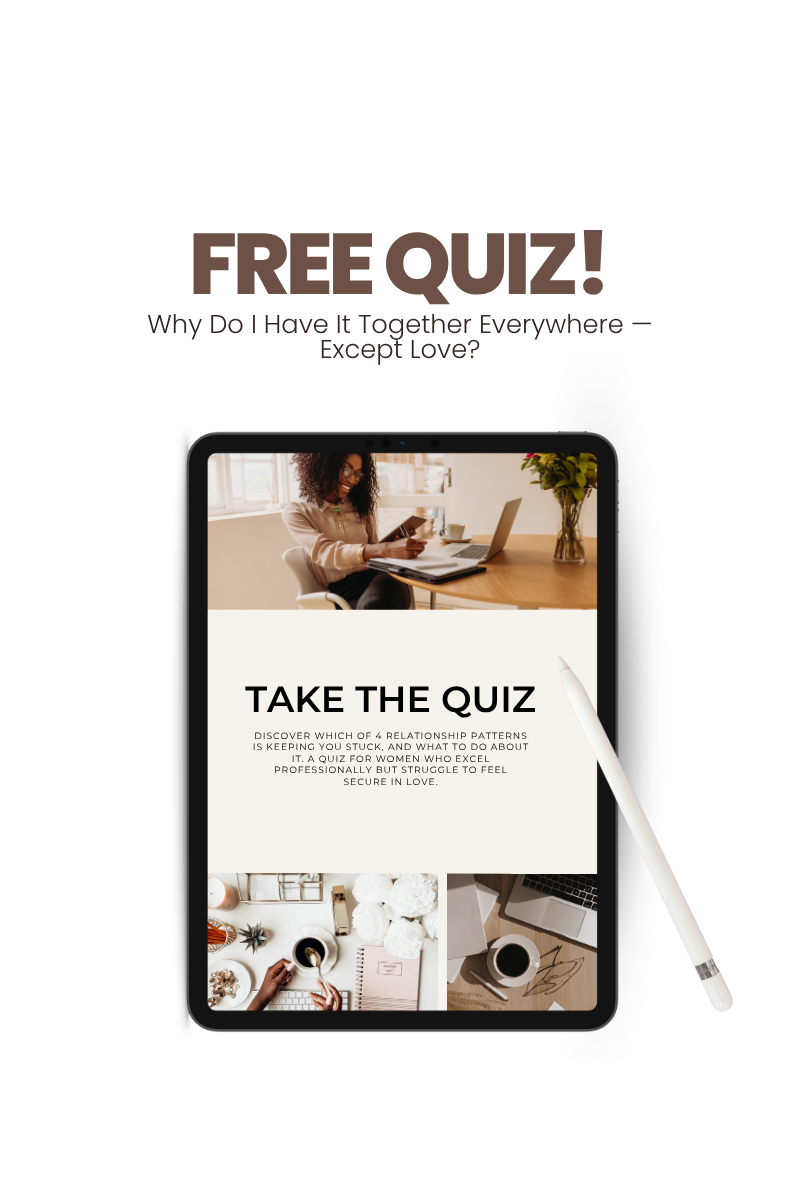
Why Do I Have It Together Everywhere — Except Love?
This free guide helps you recognize the difference between productive anxiety and the kind that's quietly running your life, so you can start responding to it instead of just managing it.
6. You're afraid of being "too much."
You edit yourself. You hold back. You feel the impulse to express something, a feeling, a need, a frustration, and then you run it through a filter: Will this be too much? Will this push them away?
So you say a smaller version of what you meant, or you say nothing, and the thing you needed to express goes back down. Over time, this creates a relationship where the other person has never really met all of you, and you're left feeling unseen in ways you can't entirely explain, because you were the one who hid.
7. You replay conversations looking for what you did wrong.
After a hard conversation, or sometimes even after a perfectly ordinary one, your mind goes back through it. You reexamine your word choices. You wonder if you came across the wrong way. You think about what you should have said differently.
This pattern, the endless post-processing, is exhausting, and it rarely produces anything useful. But it persists because it feels like control. Like if you can figure out where you went wrong, you can prevent the outcome you're afraid of.
8. The hot-and-cold treatment wrecks you.
You can handle difficulty. You can handle hard conversations and real problems. What you can't handle is inconsistency. When someone is warm and engaged one week and distant and flat the next, it destabilizes you in a way that's hard to explain to people who don't experience it.
The unpredictability keeps you in a constant state of low-level monitoring, trying to figure out what changed and what you need to do to get back to the good version. This is also how anxious attachment becomes vulnerable to unhealthy dynamics, because intermittent reinforcement is, neurologically, one of the most powerful ways to deepen attachment.
9. You feel responsible for managing other people's emotions.
If someone in your life is upset, even if it has nothing to do with you, you feel it as your problem to solve. You absorb their moods. You adjust your energy to match theirs. You take on the emotional labor of managing the room.
This isn't just empathy, it's a trained response to an early environment where other people's emotional states affected your sense of safety. Keeping others regulated meant keeping yourself safe. The habit followed you.
10. You want deep connection more than almost anything, but intimacy also terrifies you.
Here's the one that tends to surprise people: anxious attachment doesn't mean you're afraid of commitment. Most of the time it means the opposite, you want closeness, partnership, to be truly known by someone. What's terrifying is how much you want it and how little control you have over whether it stays.
Vulnerability feels dangerous precisely because the stakes feel so high. And so you find yourself in this painful in-between: longing for depth while bracing for loss, wanting to be seen while staying slightly out of reach.
What anxious attachment actually is, and where it comes from.
Attachment styles aren't assigned at random. They develop in early childhood in response to how consistently our caregivers responded to our needs. If that care was warm but unpredictable, sometimes attentive, sometimes distant, sometimes there and then suddenly not.
The nervous system learned that love requires monitoring. That you have to stay alert to keep it. That the connection you need can disappear if you're not paying close enough attention.
That learning doesn't go away on its own when you become an adult. It just relocates, into your romantic relationships, into the way you text back, into the way you interpret silence, into the version of love you keep unconsciously recreating because it's the one that feels familiar.
Understanding that this pattern has a history, that it isn't just who you are, but what you learned, is where the shift begins.
If you want somewhere to start outside of therapy, here are the tools I'd put in your hands first.
You don't have to keep running this pattern.
Anxious attachment is one of the most treatable, most workable patterns there is. Not because it's simple, but because the people who carry it tend to be extraordinarily self-aware, deeply motivated, and genuinely invested in the health of their relationships. That's not nothing. That's actually most of the work.
The next step is understanding your specific version of this, because anxious attachment doesn't look the same in every woman. How it shows up for you depends on your history, your patterns, and what you've built around it over the years.
Three minutes. Four possible results. A personalized breakdown of your relationship pattern and what it's actually costing you, so you can finally stop operating from a place you never consciously chose.
Want to understand anxious attachment more deeply before diving in? Start here: What Is Anxious Attachment? A Guide for Women Who Love Hard
Recognizing yourself in this list isn't a diagnosis. It's a door. And walking through it, getting curious about the pattern instead of ashamed of it, is one of the most meaningful things you can do for every relationship in your life, including the one you have with yourself.
KEEP READING
More for the high-achieving woman.


Ready to stop reading about it and actually change it?
Book a free 15-minute consultation — no pressure, no commitment.

You know he's not good for you. Your friends see it. Your body feels it. So why can't you walk away? This post gets honest about the real reasons letting go feels impossible, even when you know better.