

You Know He's Not Good for You. So Why Can't You Let Go?
This post contains affiliate links. I may earn a small commission at no cost to you. I only recommend products I'd genuinely suggest to a client.

You know it. On some level, you've known it for a while.
Your friends have said it carefully, in that measured tone they use when they don't want to upset you. Your body has said it louder, the stomach drop when his name doesn't appear, the shallow breathing when it does. Your anxiety has been sending the message on repeat.
And still, you stay. Or you leave and come back. Or you're gone but not really, because he's still the first thing you think about in the morning and the last thing you're turning over at night.
This isn't a character flaw. It isn't weakness, and it isn't stupidity, not for a woman who has clearly figured out how to navigate every other complicated thing in her life. What it is, more often than not, is emotional attachment that formed in conditions that had very little to do with love and everything to do with your nervous system trying to survive.
Here's what that actually looks like.
You feel anxious more often than you feel safe
This is worth sitting with for a moment, because a lot of women have been in anxious relationships long enough that the anxiety starts to feel normal. Expected, even. You check your phone more than you'd like to admit. You overthink his responses, or his lack of them. You find yourself scanning for signs of withdrawal, bracing before conversations, trying to read the temperature of the room before you say the wrong thing.
That's not love doing that. That's your nervous system operating in threat-detection mode, which is exactly what it does when emotional safety is inconsistent. When you can't relax in a relationship, your body is telling you something. The question is whether you're willing to listen.
[10 Signs of Anxious Attachment in Women]
The highs feel like nothing else, and so do the lows
When things are good, they are good. He's attentive, warm, the version of himself you fell for. And when he pulls away, goes cold, gets distant, picks a fight for no clear reason, it feels disproportionately devastating. Like something has been taken from you.
That cycle isn't just emotional turbulence. It's the architecture of a trauma bond. When love is intermittent, your brain starts treating the good moments as a reward, something to be chased, earned, held onto. The lows don't make you want to leave. They make you want to get back to the high. Your nervous system isn't confused about whether this person is good for you. It's addicted to the relief of when they come back.
You've become very good at explaining away the things that hurt you
You can justify almost anything at this point. The inconsistency has a reason. The emotional unavailability is just how he is, and you knew that going in. The disrespect wasn't that bad, and maybe you were being too sensitive. The lack of effort is because he's stressed, or he shows love differently, or you're asking for too much.
There's a version of generosity and understanding that is genuinely beautiful in a relationship. And then there's the version where you've quietly recalibrated your standards to make room for behavior that was never acceptable, because the alternative, losing him, feels worse than tolerating it. If you've been doing the mental gymnastics long enough, you may not even notice how much ground you've given up.
You're in love with who he could be
There's a specific kind of hope that keeps women in relationships long past the point where the evidence is clear. It's not denial exactly, you see what's in front of you. But you're also holding onto who he was in the beginning, or the version of him that shows up occasionally, or the future you built in your mind where he finally becomes who you always believed he could be.
That imagined person is real to you. The investment you made in that version of the relationship is real. But attachment to potential is still attachment to something that doesn't exist yet, and may never exist consistently. You deserve someone you don't have to wait on to become.
You believe if you love him better, something will finally change
This one tends to run deep in high-achieving women, because the belief that harder work produces better outcomes has been true in almost every other area of your life. So you try more patience. More grace. More understanding. You show up softer, or clearer, or differently than last time.
What's underneath that belief, if you look honestly, is usually the thought that his behavior is somehow a reflection of whether you've loved him well enough. That if you just find the right combination, he'll open up, show up, choose you the way you've been choosing him. But love doesn't fix unwillingness. Someone else's healing is not your assignment. And the more you make it yours, the more you lose track of your own needs in the process.
You still miss him even after he's hurt you
This is one of the most disorienting parts of unhealthy attachment, the way hurt and longing exist simultaneously, and longing somehow wins. After the argument, after the withdrawal, after the moment you saw clearly who he was and what he was willing to give, you still reach for him. You still miss him. You might even feel guilty about being upset, because the missing is so loud.
Your nervous system bonded to this person in a way that doesn't update itself based on logic or evidence. That's not a personal failing, that's just how bonding works, especially when there's been enough intensity, enough history, enough intermittent warmth to create a real attachment. The bond doesn't dissolve because the relationship isn't healthy. It has to be worked through.
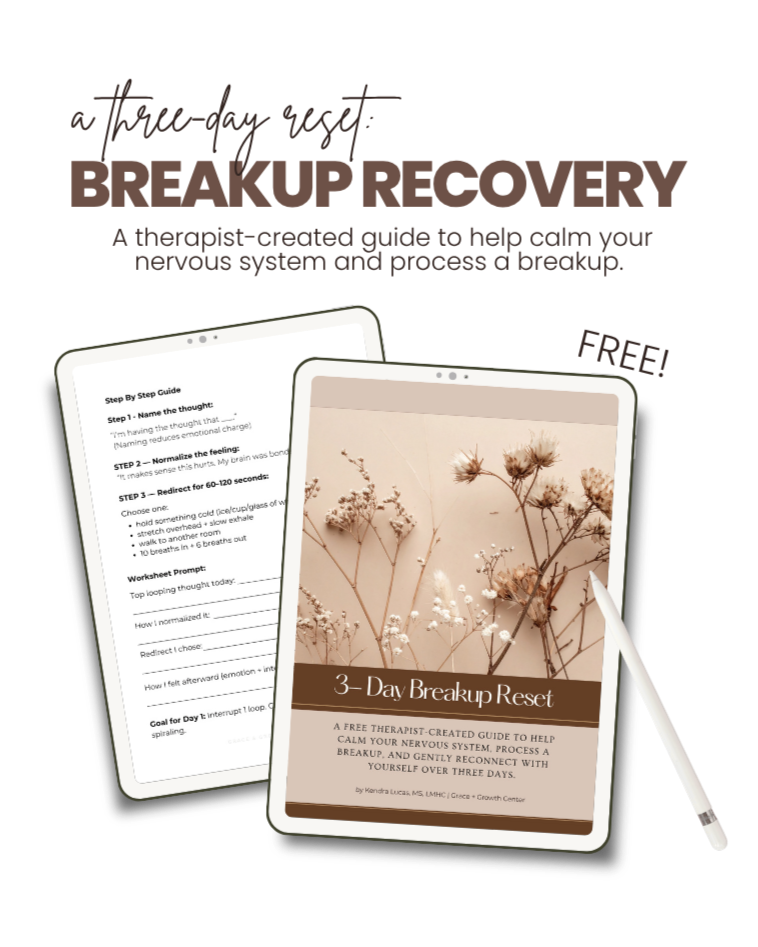
Trying to Heal From a Breakup That Still Doesn't Make Sense?
This free guide walks you through the questions you're still asking yourself, so you can start making sense of what happened and start feeling like you again.
Your sense of self has gotten tangled up with the relationship
If how you feel about yourself on a given day depends heavily on how things are going with him, if your mood, your confidence, your sense of whether you're okay tracks with his behavior, that's worth paying attention to. Healthy connection adds to who you are. It doesn't become the foundation of who you are.
When a relationship starts filling a space that's meant to be yours, your identity, your worth, your sense of safety, it stops being about him and starts being about something deeper. Something that was there before him, and that won't be resolved by staying or leaving until it gets some direct attention.
Why this happens
Unhealthy emotional attachment rarely forms because someone is naive or careless. It forms when love early in your life was inconsistent enough that your nervous system learned to work hard for it. When abandonment, real or felt, taught you that connection is something you have to earn and fight to keep. When enough intensity happened early in a relationship that your brain coded it as intimacy, even when intimacy is actually something quieter and more stable than that.
Your nervous system learned to confuse chaos with chemistry. Anxiety with passion. The chase with proof that something matters.
That's not a flaw in you. It's a pattern that made sense at some point. And patterns, once you can see them clearly, can be changed.
Not sure which pattern is running your love life?
The way you attach, and the way you detach, or can't, usually fits a specific profile. I created a quiz to help you identify exactly what's happening beneath the surface.
Here's what I know after years of sitting with high-achieving women: awareness is where everything starts. Not the fixing, not the healing, just the naming.
If you're ready to put a name to what you've been carrying, the quiz is waiting. Two minutes. No wrong answers. Just a little more clarity than you had before.
The thing worth remembering
Being emotionally attached to someone who isn't good for you doesn't mean you loved the wrong way. It means you bonded. You hoped. You invested yourself in something that mattered to you. That capacity, to love that fully, to hold on, to keep trying, is not the problem. It never was.
The work isn't to become someone who loves less. It's to understand the pattern well enough that you can start making choices from a different place, not from fear of losing him, but from a real sense of what you actually want and what you're no longer willing to settle for.
Awareness is where that starts. And you're already here.
KEEP READING
More for the high-achieving woman.


Ready to stop reading about it and actually change it?
Book a free 15-minute consultation — no pressure, no commitment.

You know he's not good for you. Your friends see it. Your body feels it. So why can't you walk away? This post gets honest about the real reasons letting go feels impossible, even when you know better.