

What If Confidence Isn’t About Being Seen?
This post contains affiliate links. I may earn a small commission at no cost to you — I only recommend products I'd genuinely suggest to a client.

Raise your hand if someone has ever said to you, “you seem so confident”.
Coworkers say it. Family members say it. Even strangers at parties say you "seem like you got it together."
I've been called confident for most of my life, and for most of that time I let people believe it meant what they thought it meant. Ease. Certainty. Having it figured out. What it actually was, most days, was a sorting system running in the background, deciding in real time what got shown and what stayed locked away until I trusted the room enough to bring it out.
Nobody hands you that system. You build it. Piece by piece, decision by decision, mostly in rooms where no one else is watching.
Which makes me wonder if we've been asking the wrong question about confidence this whole time. We keep asking how to have more of it, how to seem more sure of ourselves, how to walk into a room and look like someone who has it together. But what if confidence was never about being seen at all? What if it's actually about deciding, on your own terms, what gets seen and when?
We talk about confidence like it's a personality trait, something you either have or you don't. But most women aren't short on personality. What they're short on is a place to put the parts of themselves that haven't been safe yet, which is a lot of what I unpack in Why High-Achieving Women Often Struggle in Relationships.
Sometimes What We Call Confidence Is Actually Protection
There are women who look incredibly confident because they have become very good at managing what other people get to know about them.
They know how to keep the conversation moving when it gets too personal. They can laugh something off before anyone realizes it hurt. They know how to say, “I’m good,” in a way that closes the door before anyone thinks to ask another question.
From the outside, it can look like self-assurance. Inside, it may feel more like control.
And there’s nothing wrong with wanting control when you’ve learned that being vulnerable can leave you exposed. Sometimes protecting yourself is exactly what you needed to do at the time.
The problem comes when the protection becomes so familiar that you stop noticing what it is keeping out, because the same walls that keep disappointment away can also keep intimacy away.
The same independence that helped you survive certain seasons can eventually make it difficult to let someone help you. And, the same ability to keep your feelings to yourself can make it hard for anyone to actually know you.
That’s where confidence gets a little more complicated.
Did you lose your confidence, or did you learn to hide it
I think about this a lot with women who have spent years becoming very capable.
There’s a kind of self-reliance that gets built over time. You know how to handle things, how to figure things out, how to make things work even when no one is coming to rescue you.
So when something hurts, it gets handled. Disappointment turns into movement, and wanting something from someone else can turn into the decision that it’s safer not to need it.
Eventually, you can become so practiced at needing less that you forget you were allowed to need anything in the first place. That can make confidence confusing.
Being confident in who you are is different from feeling safe enough to let someone else see who you are. Those two things can exist very far apart.
There Are Parts of You That You Protect for a Reason
Maybe you don’t show how much you care because caring has made you feel foolish before, or you downplay how badly you want something because it feels safer than letting anyone see what it would cost you if it didn’t work out. Keeping expectations low can start to feel like a form of protection, too. Disappointment is easier to manage when you’ve already braced for it. Over time, you get very good at looking unbothered, even when you’re not.
And I don’t think the answer is to suddenly become an open book. That would miss the point.
Not everyone deserves access to every part of you. Confidence does include discernment. It includes knowing when something is yours to share and when it needs to stay protected.
The question is whether you are choosing what to share or automatically hiding. There’s a difference. One comes from knowing yourself. The other can come from being afraid of what might happen if someone really does know you.
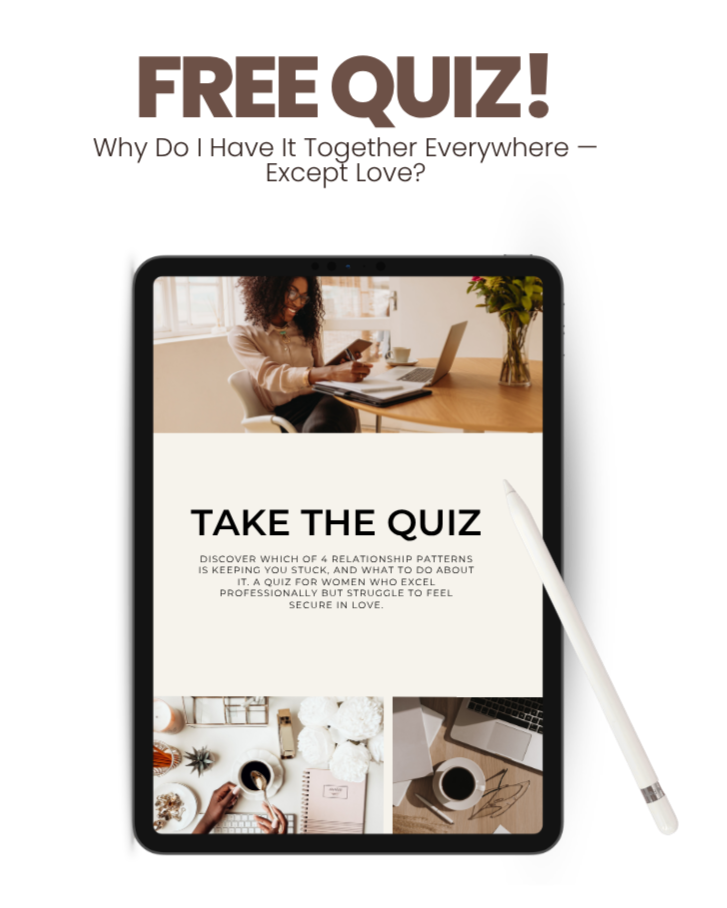
Why Do You Have It Together Everywhere — Except Love?
Take this free quiz to name the exact pattern showing up in your relationships, so you finally understand why it keeps happening.
Being Seen Requires a Different Kind of Courage
This is one of the reasons Daring Greatly by Brené Brown came onto my radar at exactly the right time.
Brown writes about vulnerability as a form of courage rather than weakness. A big part of the book is the willingness to step into the arena without having any guarantee that things will go the way you hope. You can show up honestly and still be misunderstood. You can love someone and still get hurt. You can even tell the truth and still have someone disagree with you.
There is no version of vulnerability that comes with a promise that you’ll be handled perfectly. I mean, that’s what makes it vulnerable.
And I think this matters when we talk about confidence because sometimes we’re waiting to feel completely safe before we let ourselves be seen. We want to know the person will understand, won’t judge us, and will care in return if we admit we care too. We look for some kind of proof that the risk will be worth it, but that kind of guarantee doesn’t really exist.
At some point, confidence has to become less about knowing how someone else will respond and more about trusting yourself to handle their response.
That is a very different kind of confidence.
Maybe Confidence Is Deciding What Gets to Be Seen
I don’t think confidence means showing everyone everything. It’s more about becoming intentional with what you protect and why. Learning to tell the difference between what still needs your care and what you’ve simply gotten used to keeping hidden.
Some parts of you are still tender, and it makes sense to keep them close. Some things you’re not ready to talk about, and you don’t have to force that before you’re ready. But there are also parts of you that may have been hidden for so long that you’ve started to mistake the hiding for who you are. That’s worth questioning, because you might not be as detached as you’ve learned to appear.
Maybe you care more deeply than you let on, want more than you admit, and long to be loved in a way that requires you to actually say what you need. You’ve spent years softening your opinions because being agreeable felt safer, and you’re tired of pretending nothing bothers you. What if you’re ready to let yourself be a little more visible?
Not everywhere. Not with everyone. Just enough that your life starts to feel like it actually belongs to you.
You Don’t Need Everyone to Like What They See
There is something freeing about realizing that being witnessed and being approved of are not the same thing, because you can be fully understood and still not be someone another person chooses. You can be misread, met with disagreement, or left behind, and none of those outcomes automatically mean you were wrong to show up as yourself, which is exactly where self-trust starts to matter most.
You cannot control what someone does with the version of you that you finally allow them to see. You can only decide whether you are willing to keep abandoning parts of yourself in order to control their response.
And maybe that is the part of confidence we don’t talk about enough.
To say what you actually think, admit when something matters, let someone know you were hurt instead of immediately convincing yourself you shouldn’t care, want something without pretending you’d be perfectly fine without it, or to be seen without knowing exactly what will happen next.
So What Are You Still Protecting?
So, what if confidence was never about being seen by everyone? What if it was about being willing to be seen by someone, on purpose, without needing the guarantee first?
That's a harder question than "how do I seem more confident," but it's the one that actually changes something. Not confidence as performance. Confidence as the ongoing decision to let the real version of you take up space, even when you can't predict what happens next.
Some of what you've protected still needs protecting. That's allowed. But some of it has probably been sitting behind a wall for so long that you've forgotten it was ever meant to come out.
It may be worth asking yourself whether every wall is still doing the job it was built to do, because there's a real difference between having boundaries and hiding, between discernment and emotional distance, and between knowing your worth and deciding that needing nobody is the safest way to protect it.
This pattern tends to show up everywhere, but it's usually easiest to spot in your closest relationships. I built a short quiz to help you find exactly where it shows up for you, and it's a good next step if any of this sounded familiar.
Take the quiz: Why Do I Have It Together Everywhere — Except Love?
KEEP READING
More For The High-Achieving Woman.


Ready To Stop Reading About It And Actually Change It?
Book a free 15-minute consultation — no pressure, no commitment.

What we call confidence can sometimes be protection. When you’ve spent years deciding what parts of yourself are safe to reveal, confidence becomes less about being seen and more about trusting yourself enough to be known.