

You're Not Lazy. You're Burned Out — And There's a Difference.
This post contains affiliate links. I may earn a small commission at no cost to you. I only recommend products I'd genuinely suggest to a client.

There's a version of exhaustion that sleep doesn't fix. Where you wake up already tired. Where even glancing at your to-do list feels like a physical weight settling onto your chest. Where you've lost the spark for things you used to care about, and then feel guilty for losing it, which somehow makes everything heavier.
If that sounds familiar, I want to say something clearly: that's not laziness. That's not weakness. That's not you falling apart.
That's burnout. And it's one of the most misunderstood experiences that high-achieving women go through.
What Burnout Actually Is
Burnout isn't just a tough week or a season of stress that a good vacation will fix. It's a state of chronic depletion, emotional, mental, and often physical, that develops when you've been running past your limits for too long without enough real recovery.
Psychologist Christina Maslach, who has studied burnout for decades, describes it across three dimensions: exhaustion, cynicism, that creeping sense of detachment, of I don't care anymore, and a reduced sense of accomplishment.
You start to feel like nothing you do matters, or like you can't do anything well, even when the evidence clearly says otherwise. The goalpost keeps moving, the satisfaction never arrives, and eventually you start to wonder if something is fundamentally wrong with you.
It isn't. But that thought, the one that sounds like maybe I'm just not cut out for this, is one of burnout's most convincing symptoms.
And here's the part that makes it so hard to catch in time: the same qualities that make high-achieving women so capable, the drive, the high standards, the ability to push through discomfort, are the exact qualities that make burnout easy to miss until it's already deep. You're too good at functioning to notice you're not okay.
The Signs That Are Easy to Dismiss
Because burnout builds slowly, it often disguises itself as something more manageable. You tell yourself you're just tired. That things will calm down next month. That this is just what life looks like right now, and everyone else seems to be handling it, so you should be able to as well.
But some things are worth paying attention to. Fatigue that's become your baseline, where sleep stops feeling restorative. Simple decisions that suddenly require enormous effort. An emotional flatness that isn't quite sadness, more like numbness, or a strange detachment from your own life. Small things irritating you far more than they used to.
The things that used to feel meaningful starting to feel like just more items on an endless list. Withdrawing from people you actually love, not because something is wrong between you, but because you simply don't have anything left. And underneath all of it, that relentless sense that no matter how much you accomplish, it's never quite enough.
None of those are character flaws. They're signals — your nervous system waving a flag that's been easy to ignore, until it isn't.
If you've been wondering whether what you're feeling might be more than stress, this post on burnout versus busyness goes deeper on how to tell the difference.
Why High-Achieving Women Are Especially Vulnerable
Burnout doesn't happen because you're weak. It happens because you've been strong for too long, in too many directions, with too little support.
High-achieving women often carry a particular combination of pressures: demanding careers, high internal standards, significant emotional labor in relationships, and a deep-seated belief that needing rest is somehow indulgent — that pushing through is just what responsible, capable people do. The expectation that you should be able to handle this, whatever this is, can be relentless and largely invisible, because it's coming from inside.
Add perfectionism, difficulty asking for help, and a tendency to over-function when things feel uncertain, and you have a setup where burnout isn't really a risk. It's almost inevitable, unless something changes. This connects closely to why rest feels so hard for high-achieving women, the pattern often starts well before the crash.
And in a city like Houston, where the culture rewards hustle and treats overwork as ambition, it can be genuinely difficult to locate the line between working hard and running yourself into the ground. That line matters. Crossing it repeatedly has real costs.
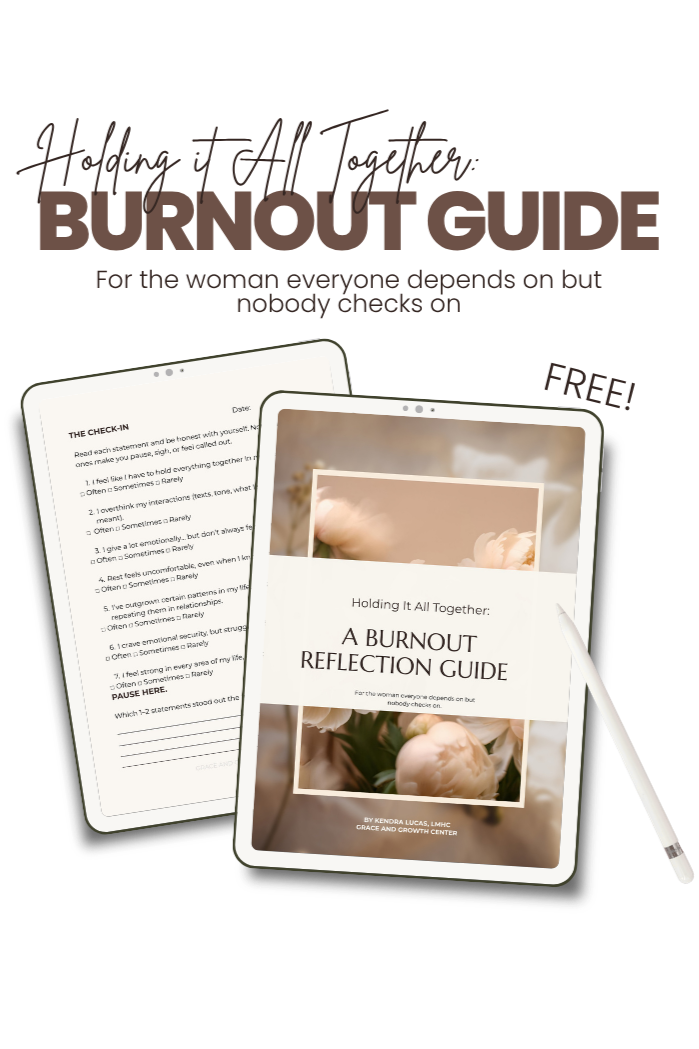
Feeling Like You're Holding Everything Together?
This free guide includes 5 powerful prompts to help you identify what's draining you, where you're carrying too much, and what needs your attention right now.
What Recovery Actually Requires
Here's something I want you to sit with: rest alone won't fix burnout. A long weekend, a vacation, sleeping in on Saturday, these help at the margins, and your body genuinely needs them. But they don't touch the patterns that created the burnout in the first place.
Real recovery usually means looking honestly at the beliefs driving your over-functioning, what you're afraid will happen if you do less, if you disappoint someone, if you take up space with your own needs. It means examining the boundaries you haven't been able to hold, and understanding why, not as a self-criticism exercise, but as genuine curiosity about what you learned about your worth and what's required to maintain it. It means separating your identity from your productivity, which is some of the most important and uncomfortable work there is.
This is what therapy is genuinely built for. Not because something is wrong with you, but because these patterns are old and deep, and it's hard to see them clearly when you're the one living inside them.
A few things can also offer your nervous system some breathing room while you figure out next steps. Building even five minutes of transition time between tasks. Practicing let me think about that before automatically saying yes. Noticing what you're doing when time stops feeling heavy, and doing more of that. Letting one thing be good enough today instead of perfect. These aren't cures, they're small acts of permission. Permission to be a person, not just a producer.
If you want support on the practical side, these are some of my favorite books for women working through burnout and rebuilding their relationship with achievement — ones I return to and recommend often. And for the internal processing work, a good journal can be a surprisingly powerful place to start untangling what's underneath the exhaustion.
You Don't Have to Hit Rock Bottom First
You don't have to wait until you completely fall apart to deserve support. You don't have to earn rest by reaching some invisible breaking point.
If you've been reading this and quietly nodding, that recognition matters. Something in you already knows that what you've been doing isn't sustainable. And that awareness, however uncomfortable, is the beginning of something.
At Grace and Growth Center, I work with high-achieving women in Houston and virtually across Texas who are tired of white-knuckling their way through their days. If you're ready to figure out what's underneath the exhaustion and build something more sustainable from there, I'd love to hear from you.
Learn more about therapy for high-achieving women at Grace and Growth Center
KEEP READING
More for the high-achieving woman.


Ready to stop reading about it and actually change it?
Book a free 15-minute consultation — no pressure, no commitment.

You got close to a goal you used to want and it felt like a stranger's life. Here's why outgrowing your own dream doesn't mean you failed it.