

Why High-Achieving Women Struggle to Rest — And How Therapy Can Help
This post contains affiliate links. I may earn a small commission at no cost to you. I only recommend products I'd genuinely suggest to a client.

You've been telling yourself the same thing for months, maybe years: I'll rest when things slow down. After the deadline. After the launch. After you've taken care of everyone who needs you. But things never actually slow down, and somewhere along the way, slowing down started to feel dangerous.
That's not laziness or lack of discipline. It's a pattern, and it runs deeper than a packed schedule.
The Pressure Is Both Loud and Quiet
High-achieving women tend to carry two kinds of pressure at once. There's the obvious kind — the deadlines, the deliverables, the people counting on you. And then there's the quieter kind that lives inside: the voice that says you should be doing more, that rest is indulgent, that stopping even briefly means you're falling behind.
That internal pressure is often the harder one to work with, because it doesn't clock out when your workday ends. It follows you into weekends, into vacations, into the moments that are supposed to feel good. Over time, the combination of external demand and internal expectation creates a kind of emotional depletion that's hard to name until you're already running on empty.
Burnout for high-achieving women rarely looks like a dramatic collapse. It looks like irritability you can't explain, a creeping sense of meaninglessness, and the strange experience of succeeding at everything while feeling like nothing is actually okay. If any of that resonates, you might want to read more about the difference between success and fulfillment, because what's exhausting you may not be the workload itself.
Why Your Brain Won't Let You Stop
Even when you carve out time to rest, your mind may have other plans. You lie down and immediately start mentally drafting emails. You sit in stillness for thirty seconds before your brain pivots to problem-solving. You find yourself replaying conversations, anticipating what's coming next, running through every possible outcome of something you can't control yet anyway.
This isn't a character flaw. It's actually your brain doing what it's been trained to do. High achievers often develop a nervous system that's wired for vigilance, for anticipating, planning, and solving. That mental agility is a real strength. But when it can't switch off, rest becomes nearly impossible, and the exhaustion compounds.
This pattern overlaps in meaningful ways with overthinking in relationships too, the same mental loops that keep you from unwinding after work can follow you into your closest connections, making it hard to be present even with the people you love most.
Feeling Like You're Holding Everything Together?
This free guide includes 5 powerful prompts to help you identify what's draining you, where you're carrying too much, and what needs your attention right now.
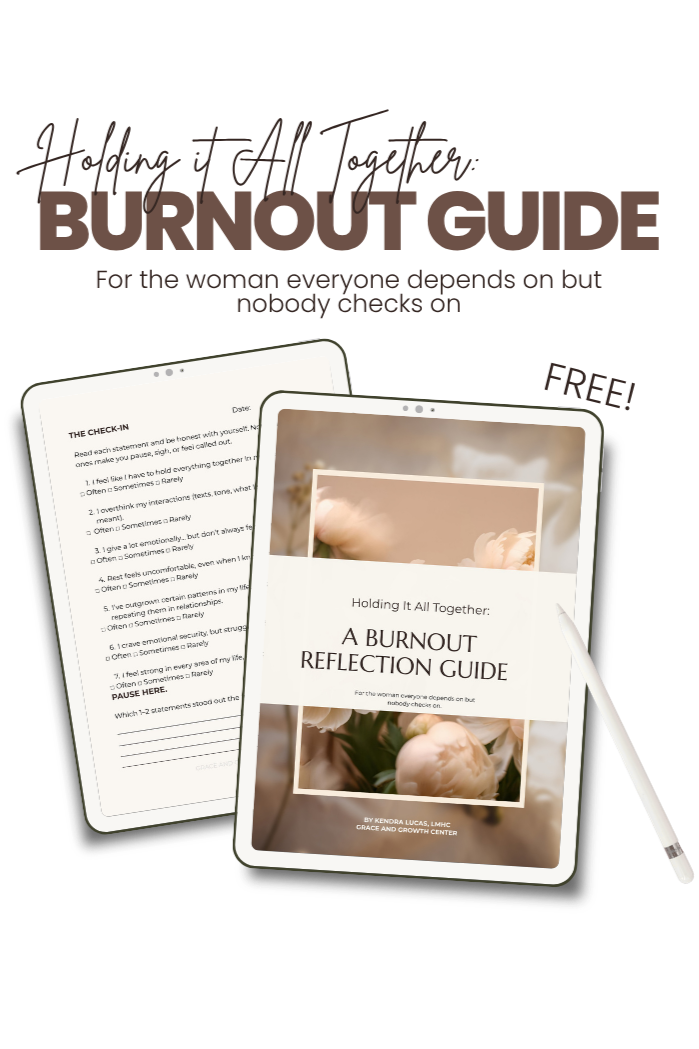
What Therapy Actually Addresses
Therapy for high-achieving women isn't about learning to want less or achieve less. It's about examining the beliefs that make rest feel like a threat rather than a necessity.
A lot of the women I work with carry an unconscious equation between their productivity and their worth, the sense that being enough requires constant output. When we start pulling that apart, what often emerges isn't laziness or avoidance. It's exhaustion that's been there for a long time, waiting for permission to be acknowledged.
In our work together, we explore where those beliefs came from, what they've cost you, and how to build a different relationship with achievement, one where you can be deeply ambitious and genuinely restored. We work on setting boundaries that actually hold, communicating needs without guilt, and developing tools for nervous system regulation that fit into a real, full life.
For further reading on what emotional burnout can look like in high-achieving women, this post on dating exhaustion touches on how depletion in one area of life rarely stays contained there.
A Few Things Worth Trying Now
If therapy feels like a next step you're considering but not ready for yet, there are smaller practices that can begin shifting the pattern. During your workday, even two or three minutes of intentional stillness, away from a screen, without a task, can interrupt the loop. Protecting one commitment each week that exists purely for you (not for productivity, not for anyone else) starts to rebuild the signal that your needs matter. And when you notice the urge to push through exhaustion rather than honor it, getting curious about that urge, rather than just obeying it, is where real change tends to begin.
A good journal can also be a powerful tool here. These are some of my favorite journals for self-reflection and emotional processing, ones I often recommend to clients who are working through burnout and the beliefs underneath it. And if you want to go deeper on the reading side, this list of books for women healing relationship patterns with achievement and self-worth is a solid place to start.
You Don't Have to Earn Your Rest
The goal isn't a perfectly balanced life where ambition and ease always coexist peacefully. The goal is a life where you're not running on fumes, where success doesn't require self-abandonment, and where you actually get to experience the life you're working so hard to build.
If you're a high-achieving woman in Texas or Florida and this is hitting close to home, Grace and Growth Center offers virtual therapy sessions designed specifically for women navigating burnout, overthinking, and the pressure to always perform. Reach out when you're ready, there's no perfect moment, and you don't have to have it all figured out first.
Learn more about therapy for high-achieving women at Grace and Growth Center
KEEP READING
More for the high-achieving woman.


Ready to stop reading about it and actually change it?
Book a free 15-minute consultation — no pressure, no commitment.

You got close to a goal you used to want and it felt like a stranger's life. Here's why outgrowing your own dream doesn't mean you failed it.