

The Emotional Rollercoaster of Breakup Recovery: What's Normal, What's Not, and How to Actually Heal
This post contains affiliate links. I may earn a small commission at no cost to you. I only recommend products I'd genuinely suggest to a client.

If you've recently gone through a breakup, chances are you've experienced at least one of the following: you woke up feeling okay, maybe even good, and by noon you were crying in your car. You spent three days convinced you were totally fine, then saw something that reminded you of them and completely fell apart. You went from grief to rage to "I'm actually grateful this happened", all in the same afternoon.
You are not losing your mind. What you are experiencing is one of the most disorienting, exhausting, and deeply human processes there is: grief.
And breakup grief is real grief. Even when the relationship wasn't healthy. Even when you knew it needed to end. Even when you're the one who ended it.
So let's talk about what's actually happening inside you, and what healing really looks like.
Your Emotions Are Not Linear, and That's Not a Problem
One of the most damaging myths about breakup recovery is that it's supposed to follow a clean, orderly path. You cry. You get angry. You bargain a little. You accept. You move on. Done.
That is not how grief works. That is not how any of this works.
What actually happens is messier and far more confusing. You might feel a rush of relief on day one, then devastation by day three. You might feel completely healed at the three-month mark, and then something as small as a smell or a song undoes all of it in seconds. You might have a phenomenal week and a terrible weekend. You'll have days where you feel like yourself again, and days where that feels impossible.
Healing is not a straight line. It's a spiral, and every time you revisit the pain, you're touching it at a slightly different level.
This fluctuation doesn't mean you're failing. It doesn't mean you loved them "too much" or that something is broken in you. It means you're human. Your nervous system is processing the loss of a relationship that was woven into your daily life, your identity, your sense of safety, and it takes time to reorganize itself around a new reality.
The Highs and Lows: What You Might Actually Feel
Here's a more honest map of what breakup recovery tends to look like emotionally. These aren't stages in a prescribed order, they're experiences that come and go, sometimes more than once.
The Shock Phase: "I can't believe this is real"
Even when you saw it coming, there's often a period of disbelief. You function, but on autopilot. You might feel surprisingly numb, that's your nervous system protecting you from taking in too much at once. Don't confuse numbness with being fine.
The Waves of Grief: "I'm fine... wait, I'm not"
Grief tends to come in waves rather than a steady current. You might have hours or even days of clarity, then get hit completely out of nowhere. This is normal. It doesn't mean you've regressed. It means the loss is real and your heart is working through it.
The Anger: "How could they? How could I?"
Anger often shows up as a companion to grief. Sometimes it's directed at them. Sometimes at yourself. Sometimes at the situation. Anger gets a bad reputation, but it's often the emotion that signals you're beginning to see what you deserve, and how this relationship fell short of that.
The "Maybe We Could Work It Out" Phase
The bargaining mind is very creative. You'll find yourself rehearsing conversations, drafting texts you won't send, convincing yourself that one more conversation could fix everything. This is your brain trying to avoid the pain of finality. It's very normal, and it doesn't mean you should act on it.
The Good Days, And the Guilt That Follows
Something that doesn't get talked about enough: the guilt people feel when they start to feel better. Like enjoying yourself means you didn't care. Like moving forward is a betrayal of what you had. It isn't. Good days are not a betrayal of what you felt. They're the beginning of what's possible.
The Reconstruction Phase: "Who am I now?"
Relationships shape our identity. When one ends, we often have to relearn ourselves outside of it. This is uncomfortable, and also deeply necessary. This is where the real growth lives, if you let yourself do the work.
If you’re exhausted with dating, this post might also resonate.
When Your Emotions Start Running the Show
Here's where I want to get honest with you about something a lot of people don't talk about in breakup recovery: the difference between feeling your emotions and being driven by them.
Your feelings are valid. All of them. The sadness, the anger, the longing, the shame, none of it needs to be suppressed or rushed through. But feelings are information. They are not instructions.
When we're in acute grief, our nervous system is often in a heightened state, think of it as the emotional equivalent of being slightly underwater. Everything is louder, more immediate, more intense. And in that state, it becomes very easy to make decisions from a place of pain rather than wisdom.
The 2am text. The angry confrontation that doesn't actually give you closure. The reaching back out because one good day made you forget all the hard ones. Checking their social media obsessively. These are not character flaws. They are your nervous system doing its best to reduce discomfort in the moment. But they tend to keep you in the cycle longer.
Reactivity in the aftermath of a breakup isn't weakness, it's what happens when your window of tolerance narrows. You have less capacity to pause, reflect, and choose a response because your system is already working overtime.
The goal isn't to never feel the emotion. The goal is to create just enough space between the feeling and the action so that you get to choose what you do with it.
Trying to Heal From a Breakup That Still Doesn't Make Sense?
This free guide walks you through the questions you're still asking yourself, so you can start making sense of what happened and start feeling like you again.
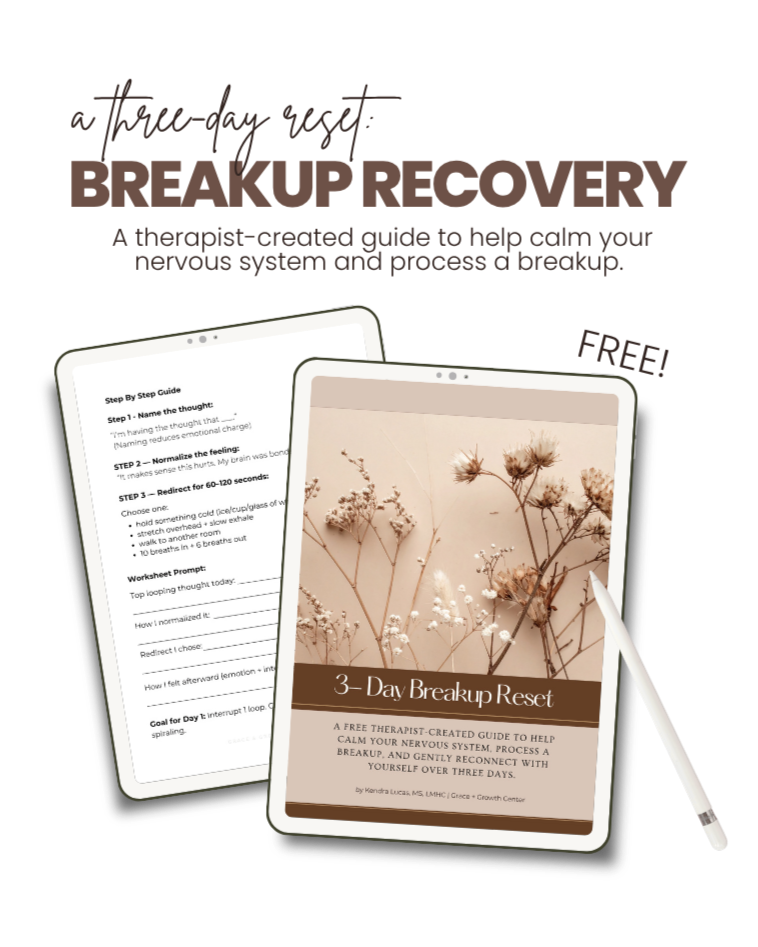
What slowing the reactive cycle actually looks like:
Name it before you act on it. When you feel the urge to reach out, check their profile, or send that message — pause and name what you're actually feeling underneath the urge. Usually it's not "I need to text them." It's "I feel scared that I made a mistake" or "I feel lonely and I want to feel connected to someone." Once you name the real feeling, the urge often loses some of its grip.
Give it a window. If the urge is strong, tell yourself: "I'll wait 24 hours. If I still feel this way, I'll revisit it." Most of the time, the urgency passes. If it doesn't, you can address it with a clearer head.
Regulate your body first. Emotional reactivity lives in the body. When you're dysregulated, your thinking brain goes partially offline. Before making any decision in the aftermath of a hard emotion, do something physical first, a walk, slow deep breathing, movement of any kind. You're not avoiding the feeling. You're giving your nervous system the signal that you're safe enough to think.
Protect the relationship with yourself. Every time you act in ways you later regret, it costs you something. Not because you're bad, but because it reinforces a story that you can't trust yourself when you're in pain. Acting from your values, even when it's hard, builds self-trust. And self-trust is exactly what you need most when you're rebuilding.
If overthinking is part of your pattern, this post might also resonate.
What Healing Actually Requires, And Where to Start
There's a difference between surviving a breakup and actually healing from one. Surviving looks like getting through the days, staying busy, managing the grief enough to function.
Healing looks like understanding what the relationship taught you, doing the work to know yourself better on the other side, and genuinely becoming someone who isn't running the same patterns into the next relationship.
Here's where to start:
1. Let yourself actually grieve. The temptation to skip the grief, to stay busy, to start dating immediately, to convince yourself you're fine, is real and understandable. But unfelt grief doesn't disappear. It shows up later in ways you don't expect: walls you put up with someone new, patterns you keep repeating, a persistent low-grade sadness you can't quite explain. Let yourself feel it. It's not forever. But it needs space to move through you.
If you're in that in-between space of hurting and still missing them, I put together a list of resources that have helped my clients through exactly this.
2. Get curious about your patterns. Every relationship is an opportunity to learn something about yourself. Try not to see it as self-blame. See it as you’re developing self-awareness. What did you tolerate that you shouldn't have? What did you need that you never asked for? Where did you abandon yourself to try to keep the peace? Getting honest about your patterns is one of the most loving things you can do for your future self.
3. Rebuild your relationship with yourself. In long relationships, we often outsource pieces of our identity, our social plans, our sense of validation, even our moods, to the other person. Part of healing is reclaiming those pieces. Who are you on a Tuesday night alone? What do you actually enjoy? What do you need to feel good in your own life, outside of a relationship? Start learning yourself the way you'd learn someone you love.
Journaling is one of the most accessible ways to start, here are some of my favorite journals for this kind of inner work
4. Regulate your nervous system, consistently. Movement, sleep, nourishment, time in nature, connection with safe people, these are not extras. They are the infrastructure of healing. When your nervous system is supported, you have more capacity to process emotion, make grounded decisions, and not completely unravel when something triggers you. Build the basics before you try to do the deeper work.
5. Don't process in isolation. There is a limit to how much self-reflection alone can do. At some point, healing in relationship, through trusted friends, community, or a therapist, becomes essential. We formed many of our relational wounds in relationship with others. And we often heal them the same way. You don't have to figure this out by yourself.
6. Set a timeline for no-contact, and hold it. This one is uncomfortable but important. Space from the person allows your nervous system to actually detach, to stop anticipating their texts, interpreting their social media, or building hope out of ambiguous interactions. This doesn't have to mean forever (though sometimes it does). It means giving yourself enough space that if and when you do re-engage, it's from a place of clarity rather than need.
7. Hold your healing lightly. Healing is not a performance. You don't have to be "over it" by a certain date or in a certain way. You are allowed to be a work in progress. The bad days don't erase the good ones. The tearful Tuesday doesn't cancel the solid Sunday. Both can be true at once. Both are part of the process.
You Are Not Behind. You Are in It.
There is no right way to do this. There is no right timeline. There are people who "get over" things quickly and are actually just numbing, and people who take their time and come out on the other side genuinely transformed. The goal isn't speed. The goal is truth.
What I want you to know, wherever you are right now: what you're feeling makes sense. The highs and the lows both make sense. The days when you feel strong and the days when you don't, all of it makes sense. You are not failing at healing. You are healing, and it looks exactly like this.
And if you need support moving through it, that's not a weakness. That's wisdom.
You don't have to do this alone.
Ready to do the deeper work? You can explore therapy at Grace & Growth Center, or if you're not sure where to start, take the free quiz to find out what's really keeping you stuck in your relationship patterns.
If something in this post stirred something in you, that's not an accident. The patterns we carry in love don't always have obvious names, but they do have names.
The quiz is a good place to start finding yours. It takes about two minutes, it's free, and it might give language to something you've been feeling for a while but couldn't quite articulate.
KEEP READING
More for the high-achieving woman.


Ready to stop reading about it and actually change it?
Book a free 15-minute consultation — no pressure, no commitment.

Some endings never come with an explanation. Here's how to stop waiting for one and give yourself the closure you never got.