

When Your Mind Won't Let Something Go
This post contains affiliate links. I may earn a small commission at no cost to you. I only recommend products I'd genuinely suggest to a client.

You know the feeling. Something happened. Maybe yesterday, maybe three weeks ago, maybe three years ago, and your brain has decided it's not done with it yet.
You replay it in the shower. You reconstruct it on your commute. You lie awake at night running through the same moment again, adjusting variables, imagining different outcomes, looking for the answer that will finally make it make sense and let you rest.
And then you replay the fact that you're replaying it, and wonder what that says about you.
If this is where you are, I want to say something before we go any further: this is not evidence that you're broken, or weak, or that healing isn't working. It's evidence that you have a nervous system, one that learned, somewhere along the way, that staying alert was how you stayed safe.
Your mind is not betraying you. It's trying to protect you.
Here's what I tell clients who come in exhausted by their own thoughts: rumination isn't a character flaw. It's a survival strategy.
When your brain replays a conversation or revisits a mistake over and over again, it's not being irrational. It's doing exactly what it was designed to do, scan for threat, review what went wrong, try to build a map that prevents future pain. The problem isn't the intention. The problem is that your brain doesn't always know the difference between useful reflection and self-punishment. It just knows it doesn't feel safe yet, and it's going to keep searching until it does.
So if you've been telling yourself to just let it go, and watching that instruction do absolutely nothing, that's why. You can't think your way out of a nervous system response. And trying harder usually just adds another layer: now you're anxious about being anxious, and ruminating about the fact that you're ruminating.
That loop is exhausting. And it's not your fault.
A Therapist Confession
I'm going to share something I tell clients when they look at me like they're the only person on earth who does this.
I do it too.
I'm a therapist. I know the neuroscience of rumination. I teach the tools. I've sat with hundreds of people through exactly this pattern and helped them find their way out of it. And I still catch myself, sometimes, stuck on a moment from earlier in the day, a tone I used, something I said, a split-second where I wonder if I showed up the right way.
I tell you this not to be relatable, but because I think it matters to know that this is not a problem that only people who are struggling have. It's a human thing. A nervous system thing. The difference between someone who ruminates and someone who doesn't isn't intelligence or emotional health or how much therapy they've done. It's usually about how safe their body currently feels.
When I'm rested, regulated, and not carrying too much, my mind moves on. When I'm depleted or stressed or haven't been taking good care of myself, it loops. That's the pattern, and once you see it, it becomes less about ‘what's wrong with me?’ and more about ‘what does my system need right now?’.
If you've been journaling through this, here are some of the journals I recommend to clients working through similar patterns.
Why it gets louder at night
If you've noticed that the replay is worst when you're trying to sleep, that's not a coincidence.
During the day, you're busy. You're productive, you're in motion, you have things to focus on. The noise of daily life gives your nervous system somewhere else to put its attention. But at night, when everything slows down and the distractions fall away, that's when your body finally has space to surface what it's been carrying.
The thoughts aren't louder at night because something is wrong. They're louder because your system finally has permission to speak. In a strange way, the racing mind at 2am is your body trying to do the work. It just doesn't have the resources to do it well when you're exhausted and alone in the dark.
This is worth knowing because it reframes the goal. The aim isn't to force your mind to be quiet. It's to give your nervous system what it actually needs so it doesn't have to work so hard.
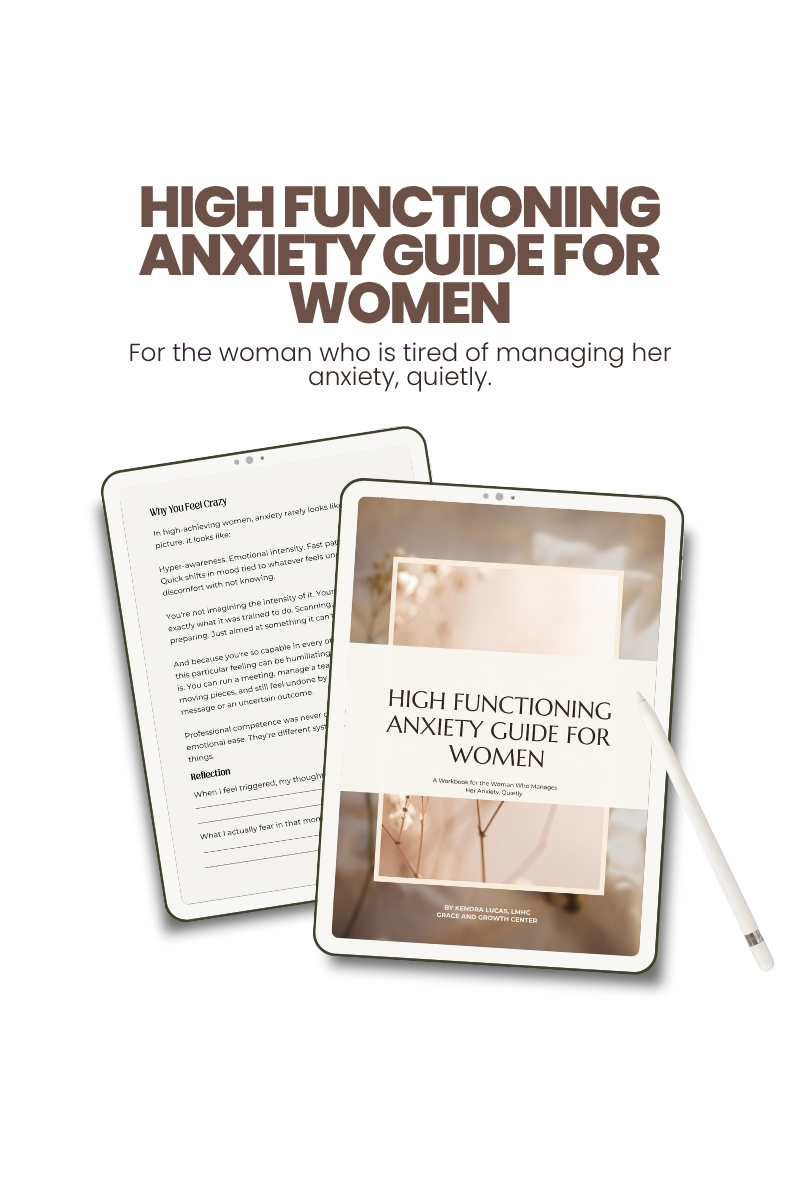
Is Your Anxiety Just... How You Function Now?
This free guide helps you recognize the difference between productive anxiety and the kind that's quietly running your life, so you can start responding to it instead of just managing it.
What Actually Helps
Not a list of hacks. Just a few things that genuinely work, offered the way I'd offer them in a session.
Name what's happening without making it mean something about you. There's a specific kind of relief that comes from being able to say, out loud or in your head: this is rumination, not truth. Not I need to figure this out, not what does it mean that I can't stop thinking about this. Just a neutral recognition that your brain is in a loop. Naming it creates a tiny bit of distance. Distance is where choice lives.
Move toward the body instead of further into the mind. This is the counterintuitive one. When thoughts are spiraling, the instinct is to think harder to find the answer that will resolve it. But the loop isn't a thinking problem. It's a safety problem. And the fastest route to safety isn't more analysis. It's slowing your breath, feeling your feet on the floor, putting your hand on your chest. These aren't tricks. They're direct communication with the part of your nervous system that's running the show.
Offer yourself the thing you'd offer a friend. If someone you loved called you at midnight saying they couldn't stop replaying something, you wouldn't tell them to just stop. You'd be gentle. You'd say of course your mind is doing that, you've been through a lot. You deserve that same response from yourself. Not because it immediately fixes anything, but because self-criticism in this state doesn't help. It just adds weight.
Set a boundary with the thought. This one sounds simple but takes practice: I can think about this tomorrow. Right now, I rest. You're not dismissing the thought or pretending it doesn't exist. You're just giving it a time and a place that isn't the inside of your skull at midnight. Sometimes the mind accepts that. Sometimes it doesn't. But it's worth trying.
If you struggle with setting boundaries without feeling guilty, this post may be helpful.
What this is really about
Underneath most rumination is an unmet need. Sometimes it's reassurance, I need to know I'm okay, that I didn't ruin something, that people don't think less of me. Sometimes it's resolution, I need this to make sense, and it doesn't yet. Sometimes it's control, if I think about it enough, I can prevent this from happening again.
None of those needs are unreasonable. But thinking harder doesn't meet them. Reassurance doesn't come from the replay. Resolution often requires sitting with uncertainty, not resolving it. And control over painful things is, most of the time, not actually available.
What does help is building the conditions where your nervous system genuinely starts to feel safer. Where it doesn't have to scan so hard, because it trusts, at a body level, that you're okay. That's slower work than a breathing exercise. It's the kind of work that therapy is actually built for.
You are not behind in your healing
I want to say this directly, because the exhaustion of this pattern can make it feel like evidence that you're not making progress.
You're not failing because your mind still loops. You're not too much because your thoughts are loud. You're not doing healing wrong because some nights are still hard.
You're tired. You're human. And you're carrying more than you probably give yourself credit for.
With the right support, and enough compassion for yourself in the meantime, your mind will learn how to rest. Not because you force it to, but because it gradually learns that it's safe enough to let go.
That's the work. And you're already doing it, just by taking it seriously enough to be here. That said, part of coming back to yourself is regulating your nervous system. Here's the list I point women toward.
If this resonated, you might also find these helpful: Why Relationship Anxiety Makes You Overthink Everything • Why you overthink simple decisions
KEEP READING
More for the high-achieving woman.


Ready to stop reading about it and actually change it?
Book a free 15-minute consultation — no pressure, no commitment.

High-achieving women are often the last to seek support, even when they're struggling. Here's why it happens and what getting help can actually look like.